Bedtime When One Kid Needs Quiet, One Needs Company
When one child needs silence to fall asleep and another needs a body in the room, stop trying to run one bedtime. Run two, separated either in time or in space. The company kid gets a person on a defined, shrinking clock — same chair, same words, same number of minutes, fewer each week. The quiet kid gets an uninterrupted runway and a sound floor that covers the rest of the house instead of a house pretending to be empty. The mistake is deciding one need is legitimate and the other is a habit. Both are real. They just cannot be met in the same ten minutes by the same adult.
I have both in my lineup. One twin falls asleep in four minutes if nobody speaks to her; the other lies awake for an hour unless somebody is sitting where she can see them. For two years I ran whichever bedtime suited whoever was louder about it, which meant one of them quietly lost every night.
Two opposite needs, both real
Sleep-onset needs are not a moral ranking. Some kids drop off by shutting stimulation down; others drop off by confirming they are not alone. Neither is manipulation, and neither is something you fix by explaining it to a five-year-old at 8pm.
What matters operationally is that the two needs are actively incompatible in one room at one time. Your presence — breathing, shifting, the chair creaking — is the reassurance one kid requires and the stimulation the other is fighting. There is no setting of your body that serves both, so stop looking for it. The whole solve is refusing to run them concurrently.
Start the quiet kid first, always
Order matters more than anything else here, and it goes against instinct. The kid who needs company is the one making noise about bedtime, so they pull the attention. Put them second anyway.
The quiet kid’s routine is short and ends with you leaving: six to ten minutes and you are free, with the whole evening left for the child who needs you present. Reverse it and the quiet kid lies awake in a lit room listening to you settle their sibling — precisely the stimulation they cannot fall asleep through. One bedtime is elastic and one is not. Spend the elastic one on the kid who needs the minutes.
This is the same sequencing logic as running a staggered bedtime for kids sharing a room — the difference is that here you are staggering by need, not by age or wake window.
The company kid gets a person — on a shrinking clock
“I’ll stay with you” turns into fifty minutes on a bedroom floor unless it has edges. Give the presence a shape:
- A fixed spot. A chair, not the bed. Sitting on the mattress makes you part of the sleep equipment; a chair three feet away is a person in the room, which is what they actually asked for.
- A stated length. “I’m sitting here until the sound machine has been on for ten minutes.” Say it the same way every night. The predictability is doing more work than the duration.
- A move plan. Every four or five nights the chair goes a foot closer to the door. Then the doorway. Then the landing with the door open and you audibly present. Two or three weeks of that, in a house that never skips a night, usually gets you out of the room.
- No conversation. Present, not entertaining. Answer nothing after lights out except a whispered “it’s sleep time.”
A transitional object carries a surprising amount of this weight once it is age-appropriate — worth reading when a lovey is safe to introduce before you hand one to a young sleeper, because the safe age is later than most people assume.
Protect the runway instead of silencing the house
You cannot make a house with several kids in it silent, and trying is how everyone ends up whisper-shouting on the stairs. Aim for a constant sound floor rather than a quiet one: a steady mechanical hum masks the variable noises — a door, a laugh, a dropped shoe — that actually wake a sensitive sleeper.
A fan-based machine like the Dohm works well for this because it produces one unchanging tone rather than a looping track with a seam in it. Put it between the sleeping kid and the noise, not next to their head.
Then defend a thirty-minute runway: no vacuum, no doorbell errands, no older sibling sent upstairs for something during that window. The quiet kid does not need the house asleep, only unsurprising. Everything in the bedtime plan for a highly sensitive child in a loud house applies here, and the runway is the part that matters most.
Sharing a room: stagger, then zone
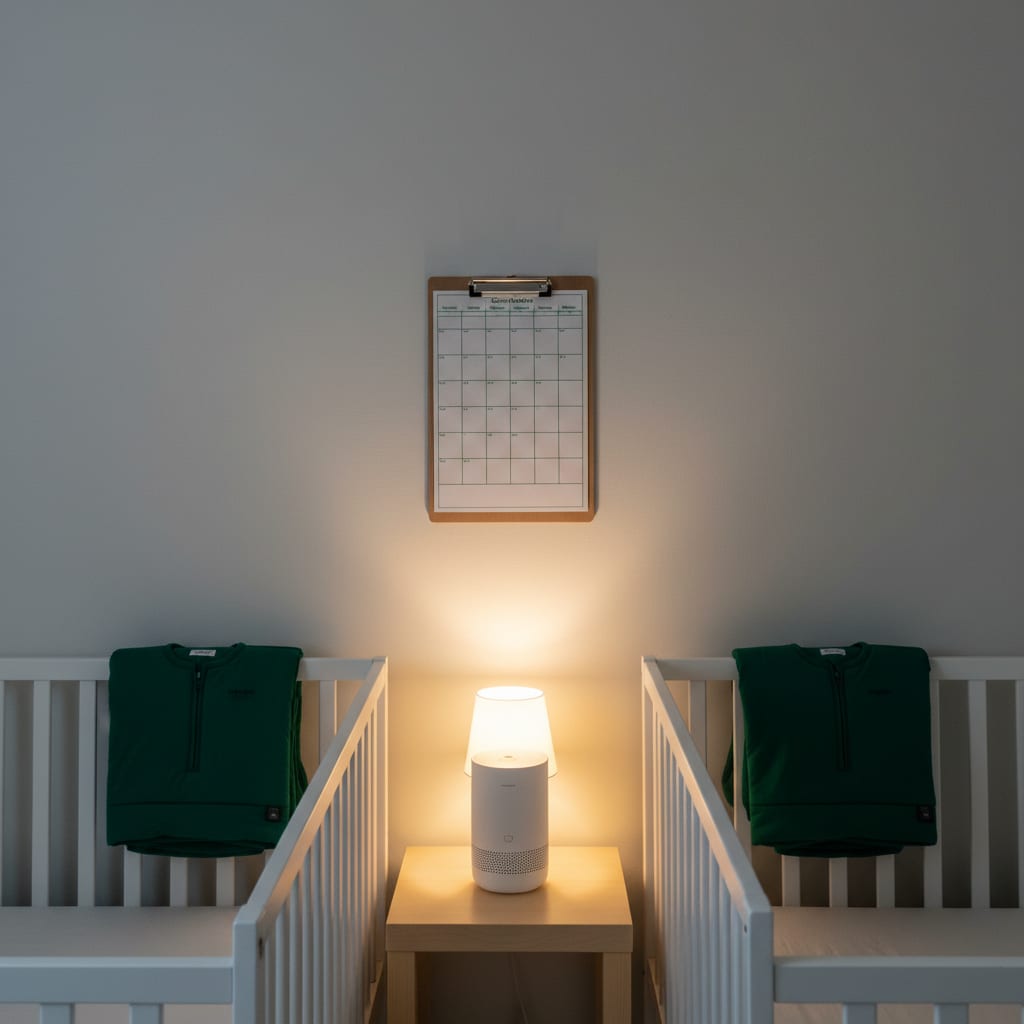
If both kids sleep in the same room, the quiet one goes in first and is asleep before the other arrives. That is non-negotiable and it means the company kid stays downstairs, in pyjamas, teeth done, doing something low-key with you for those extra minutes — not sent to bed to wait.
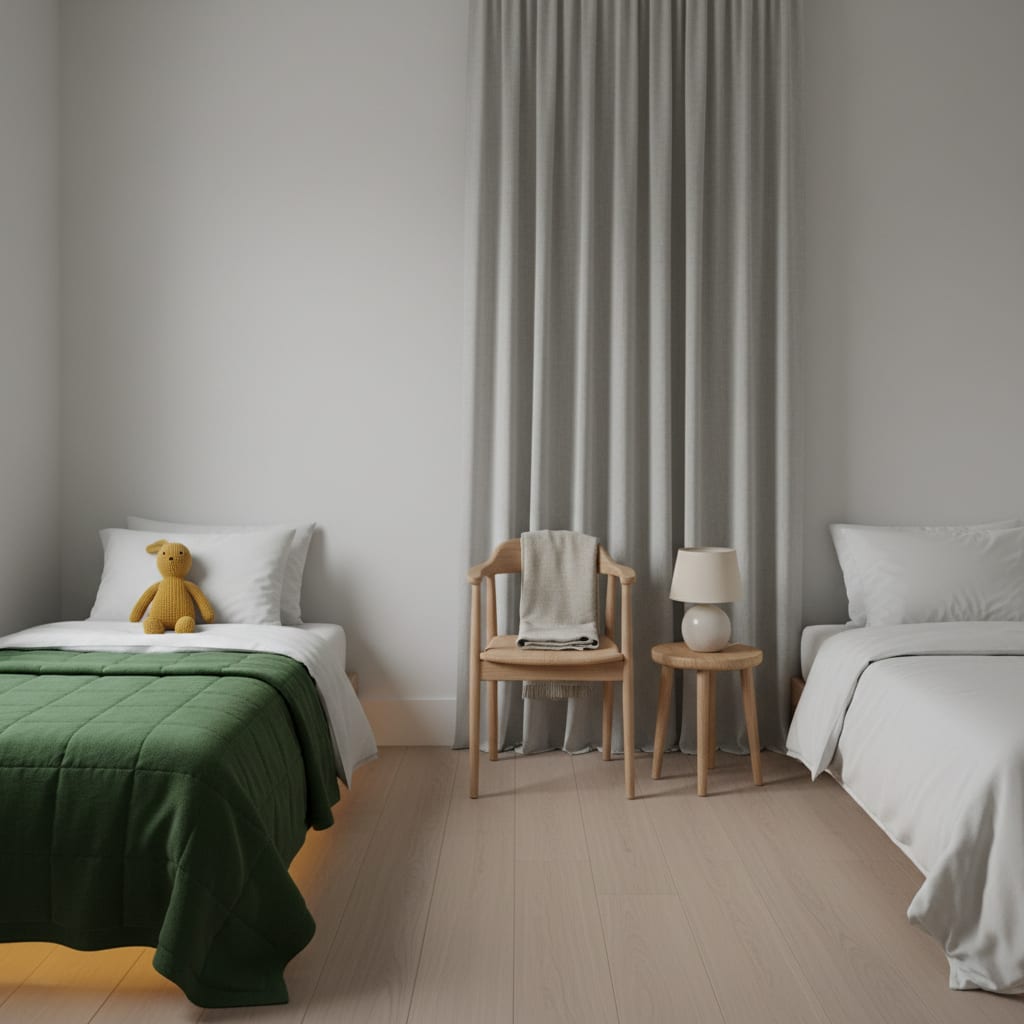
Then zone the room: the sleeper’s bed away from the door, the sound machine on their side, the low light on the other. The long-term ground rules are in the siblings sharing a room guide; the one worth enforcing hardest is that the second kid in enters at a whisper and never talks to a sleeping sibling, for any reason.
Two rooms, one hallway
Separate rooms make this easier and introduce exactly one problem: you are audible from the hallway. Sitting with the company kid means light and voices the quiet kid hears through their door.
Shut both doors. Use a low plug-in light in the hallway rather than the overhead, and keep the chair session inside the room with the door closed rather than parked in the doorway broadcasting to the whole floor. The same corridor thinking that stops an older sibling waking the baby works on adults, and adults are the ones on the landing at 8pm.
Solo nights: what one adult can actually cover
Some nights there is one of you. Then the sequence is the whole system: quiet kid down, door shut, sound floor on, then the chair session with the other. Do not alternate between two rooms — you will do neither properly and both kids will be awake at nine.
If older kids need parking while you sit, give them a named job: an audiobook in another room, a bath that runs long, a big-kid lights-out that is genuinely later. A defined holding pattern beats improvising, and they can carry it once it stops changing nightly.
When it isn’t temperament
Needing company at bedtime is normal at plenty of ages. Some things sit outside it: a child who is frightened rather than reluctant, distress that ramps rather than settles, a sudden change in a kid who used to be fine, snoring or long breathing pauses, or night waking that starts running for hours. Those are worth a pediatrician’s ear rather than a better chair plan. Persistent night waking in a toddler in particular has its own logic — the toddler night-waking playbook is a better starting point than anything in this post, which is about falling asleep, not staying that way.

FAQ: bedtime with two different sleep needs
Is it unfair that one kid gets me in the room and the other doesn’t? Fair means each kid gets what they need, not that both get the same thing. If it becomes a live grievance, name it out loud: “you fall asleep fastest on your own, she falls asleep fastest with somebody there.” Kids handle a stated difference better than a pretended sameness.
How long should the shrinking-chair process take? Usually two to three weeks in a house that runs it consistently, longer after an illness or a new sibling. Slower is fine; skipping nights is what resets it.
My company kid falls asleep, then comes to find me at 1am. Same problem? No — night waking needs a different fix. This plan still helps, because a kid who goes down without you is likelier to resettle without you, but do not judge it on 1am.
Both of mine want company. Now what? Then you have a sequencing problem rather than a conflict. Youngest first, shortest session first, and put the two sessions back to back so you are not climbing the stairs twice.