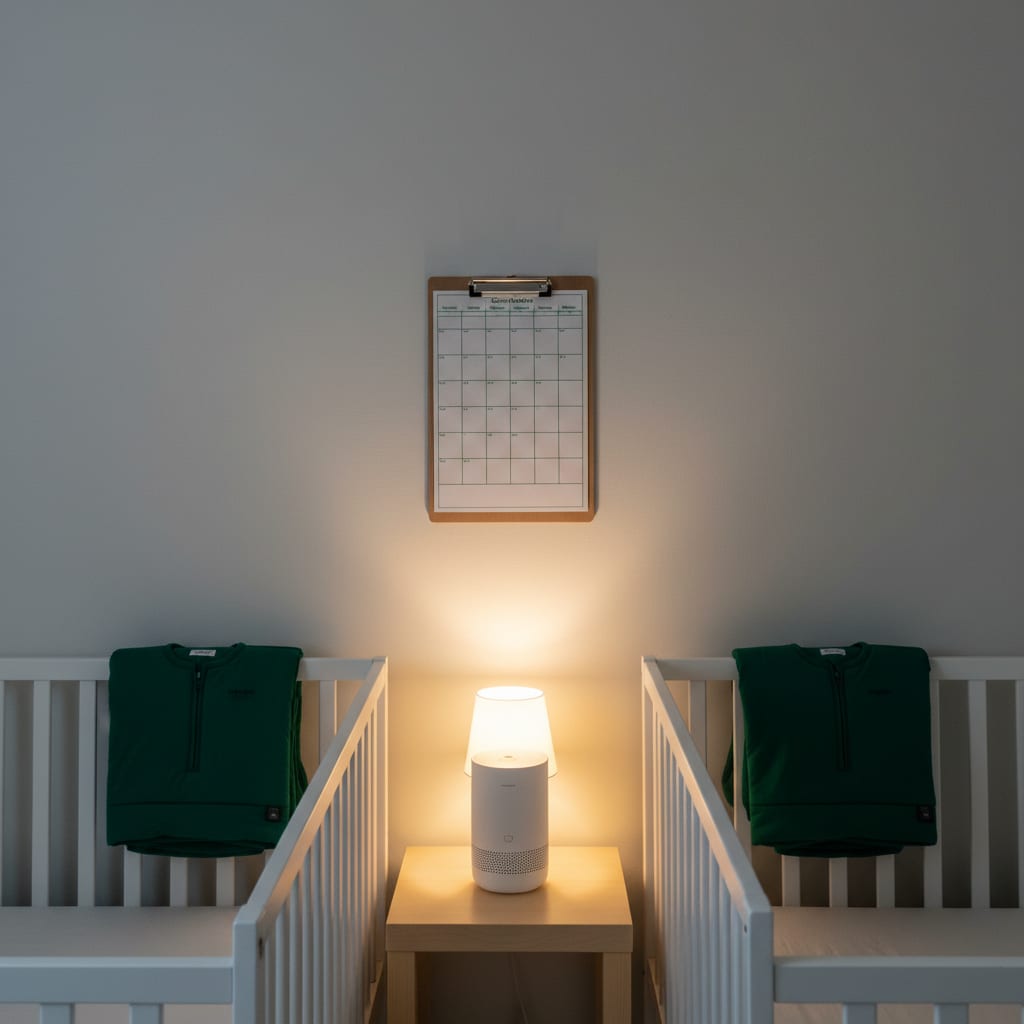
Bedtime for a Highly Sensitive Child in a Loud House
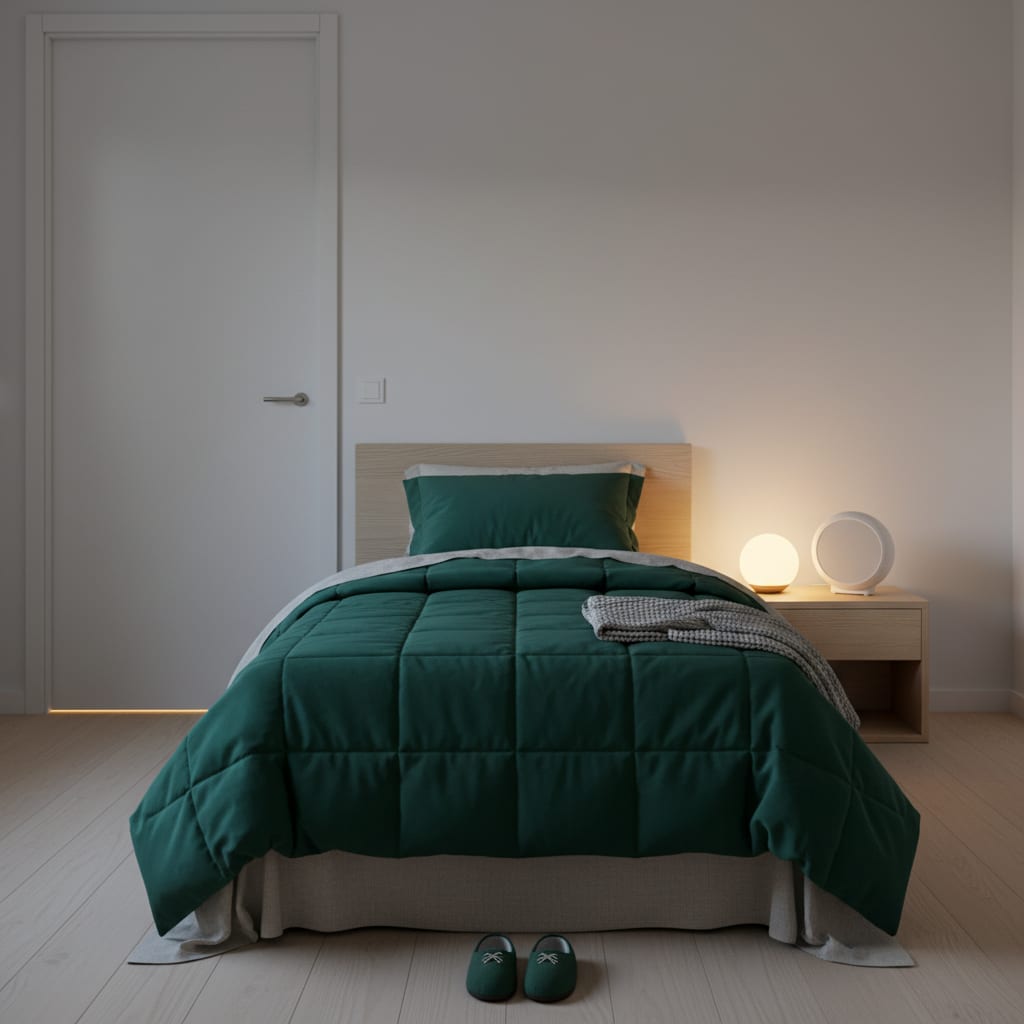
Bedtime for a highly sensitive child in a loud house works by protecting one kid’s last thirty minutes — not by making the whole household quiet. That child gets an earlier, low-stimulus runway, a sensory setup identical every night, and a decompression job to come down from the day’s noise; everyone else keeps their normal evening. Running a library-quiet house with four kids in it fails inside a week, and breeds resentment in everyone who isn’t the sensitive one.
What “highly sensitive” means here — and what it doesn’t
Highly sensitive describes temperament: a kid who notices more, reacts harder to noise, light, texture and transitions, and needs longer to come down from a stimulating day. A normal variation in wiring — and in a big family, easy to spot: they melt down at the end of a great day, not a bad one.
It is not a diagnosis, not a synonym for autism, ADHD or sensory processing disorder, and nothing here is a screening tool. If reactions are severe, worsening, interfering with school, or come alongside developmental concerns — or bedtime distress is extreme rather than just slow — that’s a pediatrician conversation, not a blog one.
Why a big, loud house breaks this kid’s bedtime specifically
Sensitive kids run a stimulation tab all day and settle it at night. In a full house the tab is enormous: five conversations, a sibling’s trumpet, someone crying about a sock. None of it is a problem in the moment; all of it accumulates. Then comes the 6pm crescendo, the loudest hour of a big family’s day, stacked directly against a bedtime. The sensitive kid arrives already at capacity, and what follows reads as “they won’t go to bed” when the runway they needed got spent on dinner cleanup. So: this kid’s problem is usually the hour before bedtime, and the fix is timing, not volume.
The protected runway: move one kid, not the house
Move the sensitive kid one slot earlier; the loud kids take the late slot. In our house:
- First shift on the bathroom. Bath before the crowd. Waiting in a hallway listening to the noise is stimulation billed straight to the tab.
- They exit the group at a fixed time, announced in advance. Not “when things calm down” — things never calm down.
- The runway is low-stimulus, not silent. Nobody else has to whisper; the point is that this kid isn’t in the middle of it.
- An adult does the runway with them. The hard part in a big family, and the part that works: ten minutes of undivided attention buys more settling than any gadget.
- The loud kids go later, on purpose. They get the boisterous end of the evening, and the sensitive kid is asleep behind a closed door before the volume peaks.
It’s the staggering logic that makes shared rooms survivable, and the two stack neatly — the staggered bedtime system has the roommate mechanics.
The sensory envelope: four inputs, identical every night
Sensitive kids don’t need a special environment so much as an unchanging one. Lock four inputs and stop touching them:
Sound. Continuous white noise, all night, moderate volume, placed away from the child’s head — the highest-value item in a loud house, because it raises the floor so the hallway stops registering as events. A mechanical-fan machine like the Yogasleep Dohm suits sensitive kids better than looping digital tracks, which some lock onto and hear repeating; Betteroo’s rundown of sound machines worth the shelf space covers the wider field.
Light. Dark, and the same dark nightly. A nightlight stays on all night — one switched off after they’re asleep produces a 1am wake in a room that has changed.
Temperature. Cool and consistent — they notice being slightly too warm long before they can explain it.
Texture. Tag-free pajamas, same sheets, same blanket weight, same room layout at lights-out. Don’t surprise this child with new bedding on a school night.
The wind-down sequence, and the decompression job
Same order, every night — sensitive kids settle on sequence, not content. Ours: bathroom, pajamas, one glass of water, two books, lights out, three minutes of talking, door.
The part people skip is the decompression job: a repetitive, low-demand physical task that lets a full head empty out — matching socks, filling tomorrow’s water bottles, lining up shoes. Not a chore-as-punishment; a landing pattern. Talking rarely works here, because a sensitive kid asked “how was your day?” at 7:40 will re-live the day, at volume.
And give them a place to go: a bottom bunk with a curtain, a closet corner with a cushion, the laundry room. Not exile — a door they can choose. Sensitive kids in busy houses need a legitimate way to leave the room that isn’t storming off.
Don’t quarantine them — the sibling problem
The failure mode is turning one child’s temperament into everyone’s rules; “we all have to be quiet for her” produces exactly the resentment you’d expect. So: no house-wide silence. The rule is about place, not volume — loud outside a sleeping kid’s door after 7:30 is the only line. Pay the older kids for their part like any job: a later lights-out, first bathroom shift in the morning. And never explain a sibling’s temperament as fragility in front of them; “he goes first because he goes first” is reason enough for a seven-year-old.
Roommate pairing deserves a hard look too — a sensitive kid paired with your loudest sleeper is a nightly tax. The pairing logic lives in the room-sharing playbook; fix that before buying a single sleep gadget.
Rule out the boring explanation first
Before concluding a child is too sensitive for bedtime, check whether they’re simply on the wrong schedule. Overtiredness looks exactly like sensitivity: wired at bedtime, tearful over small things, waking early. A bedtime thirty minutes too late, or a nap that should have been dropped six months ago, produces every symptom in this post — and no sensory setup fixes a schedule problem.
That’s the piece I stopped guessing at. A personalized sleep plan — a quiz-built schedule giving today’s wake windows and tonight’s target bedtime per child — takes the arithmetic off your plate when you’re running four or five bedtimes. Around $20 a month; it plans sleep, not temperament, and it won’t make your loud kids quieter. What it does is start the runway at the right hour. Same machinery as our twin bedtime system, pointed at one kid instead of two.

FAQ: bedtime for a sensitive child in a busy family
How long should the wind-down be for a highly sensitive child?
Around thirty minutes of low-stimulus time before lights out, at the same hour nightly. In a loud house that runway has to be actively protected or the evening will eat it.
Should the whole house go quiet for one sensitive child?
No — it doesn’t hold, and it breeds sibling resentment. Move the sensitive child earlier, mask the noise floor with continuous white noise, and make the rule about location rather than volume: normal noise, away from the sleeping kid’s door.
Is a highly sensitive child the same as sensory processing disorder?
No. High sensitivity is a temperament description, not a clinical diagnosis, and not the same as sensory processing disorder, autism or ADHD. If reactions are severe, worsening, or affecting school and friendships, ask your pediatrician for an evaluation.
Why does my sensitive child fall apart at bedtime after a good day?
Because good days are stimulating days — excitement runs up the same tab noise and stress do, so a birthday party often produces the hardest bedtime of the week. Plan a longer runway after big days, not a shorter one.
What if my sensitive child shares a room with a loud sibling?
Stagger the bedtimes so the sensitive child is asleep before the roommate enters, zone the white noise between the beds, and give the older kid a rehearsed silent-entry routine with a privilege attached. If the pairing itself is bad, changing who shares with whom beats every other fix.