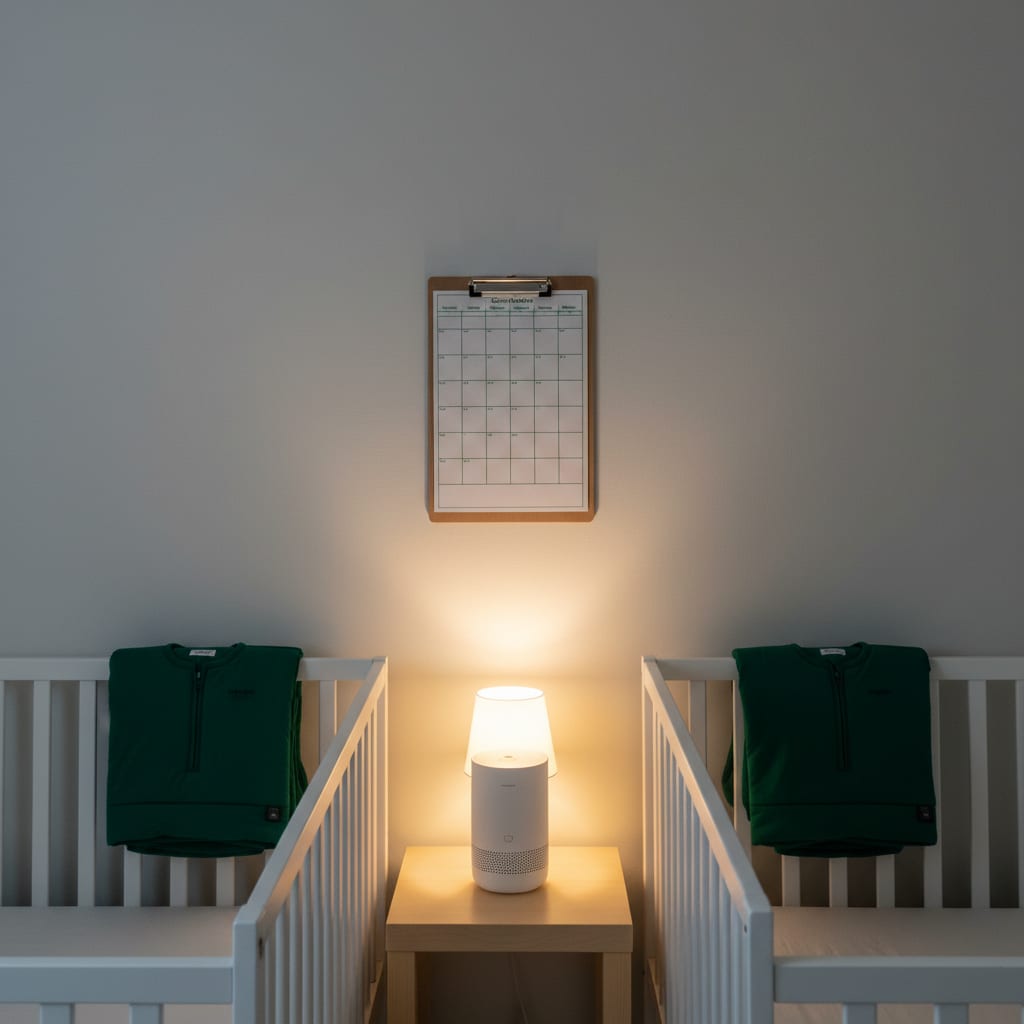
Siblings Sharing a Room: Ages, Layouts & Ground Rules
Siblings can generally share a room once the youngest is sleeping through the night reliably — for most families that means sometime after the first birthday, with the smoothest starts in the one-to-three range — and there’s no upper age limit the family itself doesn’t set (though many families give tweens more privacy, and US guidance is largely silence on siblings of the same household sharing). The real questions aren’t legal; they’re operational: who sleeps where, how you lay out one room for two sleepers, and which ground rules keep one kid’s bad night from becoming everyone’s. Five kids, three bedrooms — I run this league. Here’s the playbook.
When to make the move
The gating factor is the youngest child’s sleep maturity, not a birthday. Move a baby in with a sibling too early and you’re running a sleep regression with an audience. My working checklist before any room merge:
- The younger kid sleeps through the night more often than not
- Neither kid is mid-transition (new bed, dropping a nap, potty training — one variable at a time, always)
- You’ve run a two-week trial of naps or weekend nights in the shared room
Safe-sleep note for the youngest households: infants belong near the parents in their own crib or bassinet per standard guidance — sibling room-sharing is a post-infancy project. If the incoming roommate is a new baby, the timing logic pairs with the second-baby sleep plan: consolidate the baby’s nights first, merge rooms second.
Layouts that make one room work for two
Small shared rooms fail from furniture ambition, not square footage. The layout rules that survive contact with actual children:
- Beds on opposite walls, heads apart. Distance is a volume knob: every foot between beds subtracts conversation. Corner-L arrangements work when opposite walls don’t exist.
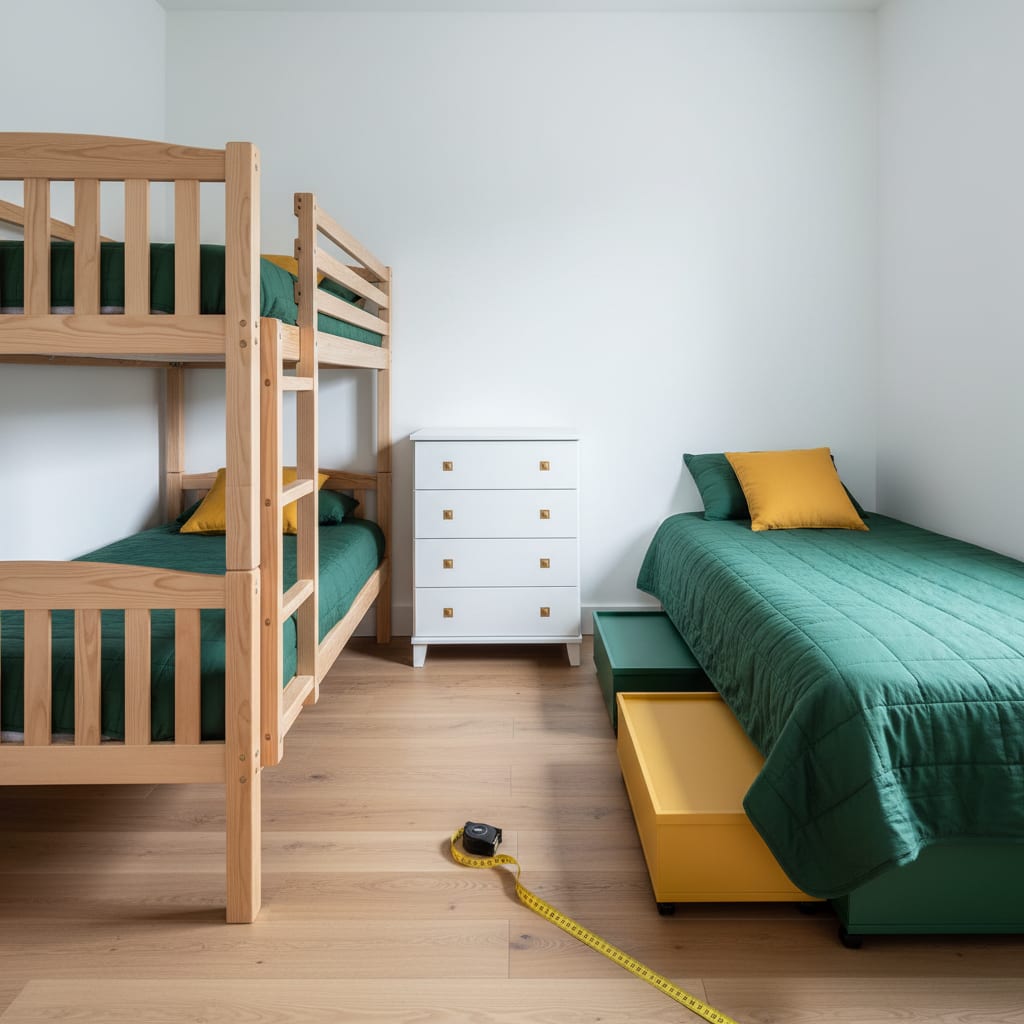
- Bunk beds are a space tool, not a default. They roughly halve the floor claimed by sleeping — and they come with age rules (top bunks are widely recommended for sixes-and-up, never younger) and a nightly negotiation about ladders. In this house bunks arrived when the twins turned six, and the floor they freed became the play zone that keeps daytime out of the beds.
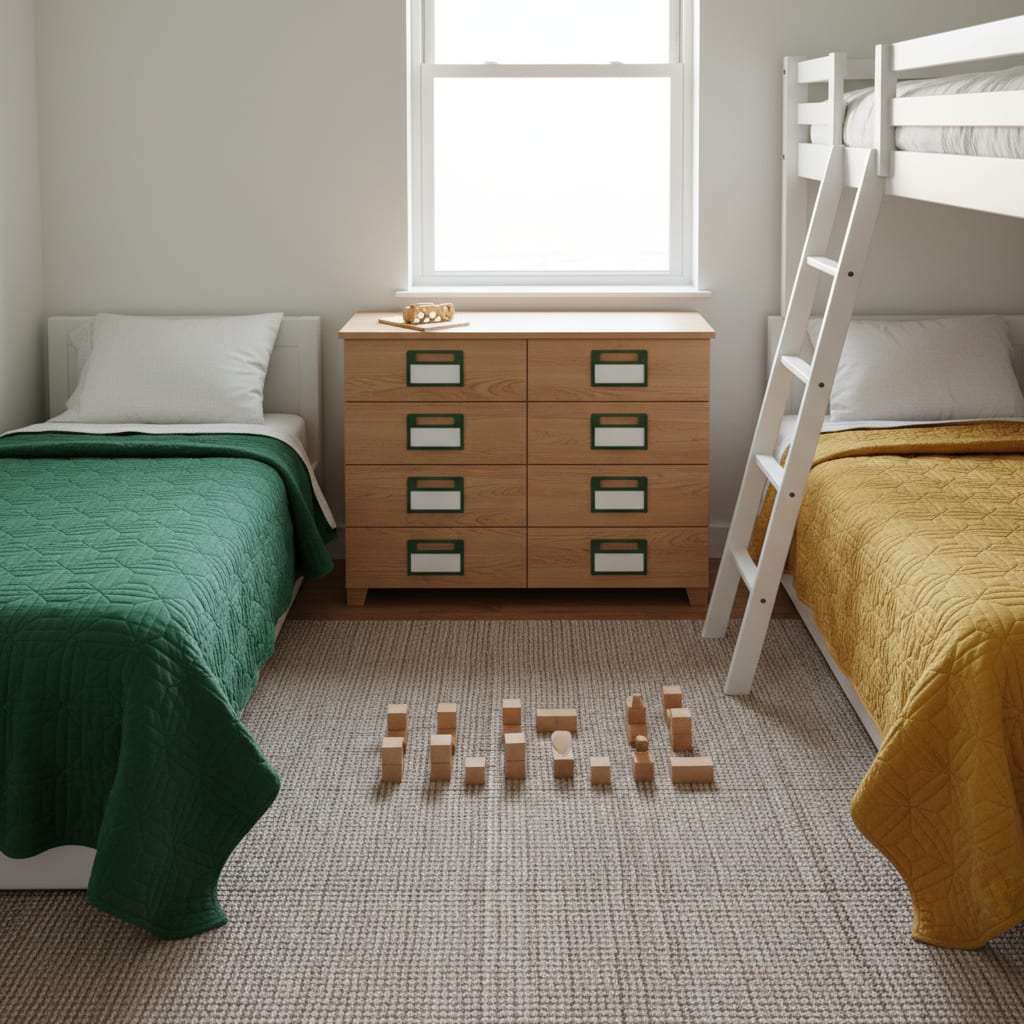
- Divide the room by function, not by owner. A sleep zone and a play zone beats two mirrored kid-halves — it makes the whole room usable by both and reduces border disputes, which siblings otherwise pursue with the energy of small nations.
- One dresser, two drawers-labels; toys rotate out. Storage in a shared room is triage: clothes in, toy overflow out to a hallway bin or closet. A shared room that also stores every toy is a bedtime full of temptation at arm’s reach.
The ground rules that protect both bedtimes
The layout is hardware; these are the software. Ours are posted on the door, because a posted rule argues so you don’t have to:
- Staggered lights-out, younger first. Fifteen to thirty minutes of gap gets the younger kid asleep before the older one enters on tiptoe-with-a-book. Same-time bedtimes for different-age kids are how whisper-parties start.
- The awake kid owes the asleep kid silence. Frame it as a duty owed between roommates, not a parent-imposed rule — big-family peer enforcement is the strongest force known to bedtime science.
- Bad nights get evacuated, not negotiated. A sick, scared, or spiraling kid leaves the room with the parent handling it; the roommate’s night is protected. One kid’s rough night must cost one kid’s sleep, not two.
- Morning rules too. The early riser exits quietly to a lit landing zone (books, quiet bin) instead of waking the roommate. Sharing a room is a 12-hour treaty, not just an 8pm one.
Twins get an asterisk: they’re the easiest room-share in the sport — pre-synced schedules, built-in white-noise tolerance — and the hardest to separate later. The synchronization machinery that makes that work is the twin sleep schedule, and it generalizes: the closer any two roommates’ schedules, the fewer rules you need. (Sleep-plan tooling like the Betteroo quiz helps here too — a baby whose schedule is dialed in is a baby who can eventually be someone’s roommate.)
When sharing stops working
Symptoms worth acting on: chronic mutual sleep loss after the rules are genuinely enforced, a big age-gap privacy collision (a ten-year-old and a three-year-old want different rooms more than either wants space), or a kid whose sleep needs are medically different. Fixes short of a bigger house: swap roommate pairings (we’ve re-drafted twice), give the light sleeper the smallest solo room — the “worst” room is a fair trade for solitude — or run staggered rooms where the baby naps in the parents’ room and night-sleeps in the shared one. Rosters are meant to be re-drafted; that’s not failure, it’s management.
FAQ: siblings sharing a room
At what age can a baby share a room with a sibling?
Once the baby reliably sleeps through the night — commonly somewhere after the first birthday. Before that, the baby rooms near the parents per safe-sleep guidance, and the older sibling keeps their sleep protected.
Can brothers and sisters share a room?
Yes — there’s no US law against opposite-sex siblings sharing in a family home. Most families naturally separate as kids approach the tween years and ask for privacy; the kids usually announce the deadline themselves.
Do bunk beds cause more sleep problems?
The bed doesn’t; the novelty does, for about two weeks. Hold the top-bunk age line (six and up is the standard guidance), enforce a no-play-on-bunks daytime rule, and the ladder becomes furniture instead of an attraction.
What if one sibling keeps waking the other?
Audit the schedule gap first — most “he keeps waking her” cases are actually bedtime-spacing problems solved by widening the stagger. If a genuinely mismatched sleeper remains, re-draft the room assignments before buying anyone a sound machine empire.