Cheap Family Activities When Tickets × 7 Is Too Much
Cheap family activities for a big household come down to one rule: stop paying per head. Anything priced per person — movie tickets, trampoline parks, aquariums, mini golf — multiplies by seven and turns a Saturday into a car payment. Anything priced per carload, per household or per year costs a big family the same as it costs a family of three, which makes it dramatically cheaper per kid. Build your outings around per-carload and free options, keep a home rotation for the other weekends, and the entertainment line stops being the thing that blows the month.
Per-carload beats per-ticket every single time
This is the whole strategy in one sentence, and it reorganizes what a big family should do for fun.
Things that charge by the vehicle or the household:
- National parks and most state parks. Entrance fees at national parks are typically charged per vehicle, and the annual America the Beautiful pass covers a carload — one price whether you bring two people or seven. Check current pricing at nps.gov before you go, since fees vary by park.
- Drive-in movies, where they still exist, are usually per car or have a modest per-person add-on.
- Beaches, lakes and trailheads with parking fees rather than admission.
- Annual family memberships at a zoo, science museum or children’s museum. A membership priced for “two adults plus kids in the household” is the single best value a big family can buy, because the per-visit cost falls every time you go — and with a big crew you’ll go on rainy Saturdays purely because it’s already paid for.
The mental shift: for us, an annual membership isn’t a splurge, it’s a substitute for tickets. One membership can replace six or eight paid outings a year, and it converts an unpredictable entertainment line into a fixed one — exactly the move that makes a large family budget hold together.
Free days, free tiers and the library card you’re underusing
Almost every paid attraction has a free door somewhere. Finding them is a 20-minute research job once a year, not an ongoing hunt.
- Free-admission days. Many museums run a free evening or one free day a month. Some run a free week in the off-season. Put the ones near you on the calendar in January and you have a year of outings.
- Library passes. A huge number of public libraries lend museum and zoo passes with a library card. This is the most consistently overlooked benefit in the country, and it’s designed exactly for the family that can’t absorb seven admissions.
- Library programming itself — story hours, LEGO clubs, teen nights, summer reading with prizes. Free, air-conditioned, and it runs all summer.
- Parks and rec. Municipal pools, splash pads, open-gym hours and rec-league sports are priced far below private equivalents, and many run resident discounts or a sliding scale.
- Community college and university events. Student theater, planetarium shows, home games in non-revenue sports — often free or a few dollars, and genuinely good.
- Fire stations, farms and factories. Open houses and tours are free far more often than people assume, and small kids rate them above things that cost $30 a head.
The home rotation that stops “we never do anything”
You cannot go out every weekend at this headcount, and you shouldn’t try. What kills morale isn’t staying home — it’s staying home with nothing planned, which reads to kids as an absence rather than a choice. So make the at-home weekend a scheduled event with a name.
Ours runs on a four-slot rotation, one per weekend:
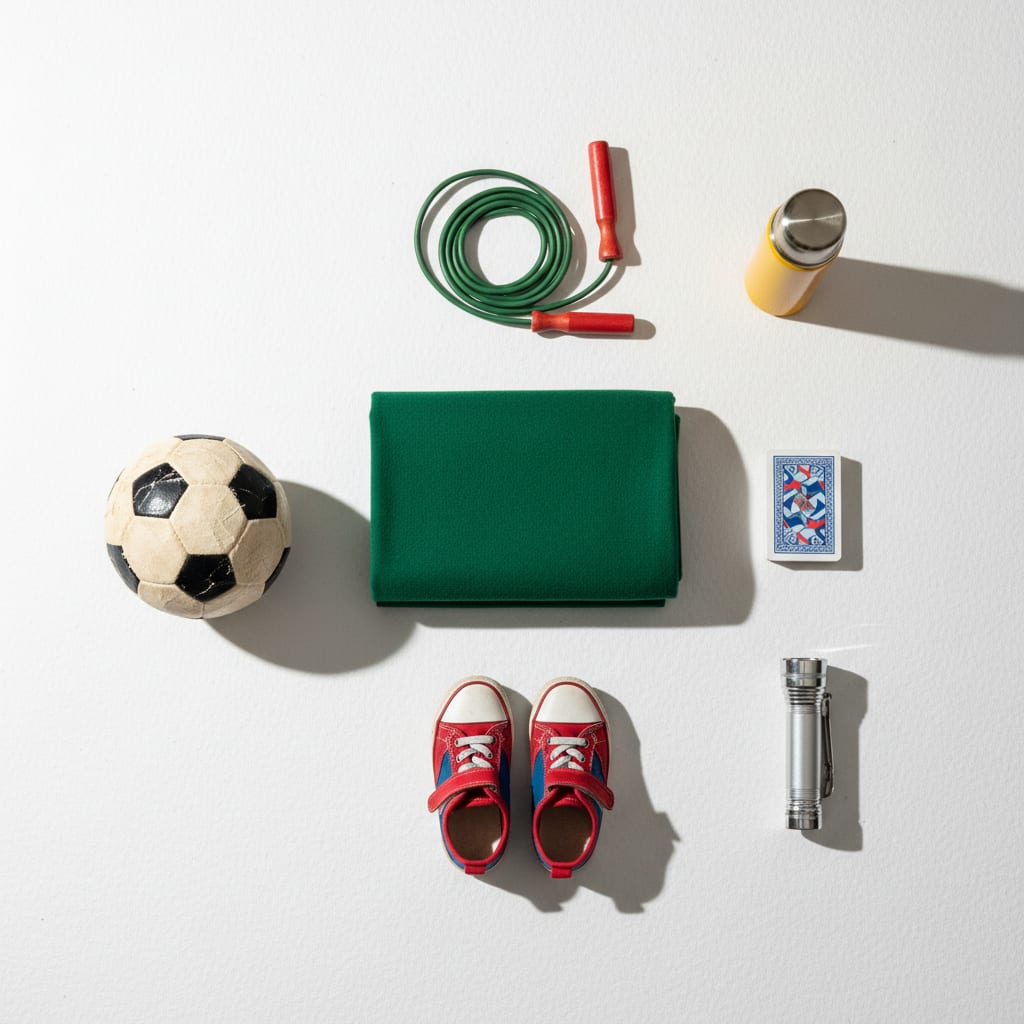
Tournament night. A bracket, a whiteboard, and a game everyone from six to eleven can play. Card and dice games are the cheapest entertainment per hour in existence and they scale to seven players without buying anything extra — a classic UNO deck plus a couple of decks of playing cards covers more evenings than any console. Winner picks next week’s snack.
Kitchen night. Pizza built by hand, tacos assembled on the counter, a bake-off with two teams. This doubles as training — the same crew logic behind kid kitchen jobs by age — and dinner is already in the budget, so the entertainment is free.
Outside night. Flashlight tag, a bike loop, a fire pit, a walk somewhere with a destination. Cheapest possible hour; also the one everyone sleeps best after.
Screen night, on purpose. Movie chosen by rotating pick, popcorn on the stove, lights off. Deliberate and scheduled beats accidental and all weekend.
The rotation matters more than the content. Kids in a big family are extremely tolerant of cheap plans and extremely intolerant of no plans.
Make the outings you do pay for count
When you are paying, a few habits keep the multiplier honest:
- Eat before you go, and bring water. Concessions are where per-head pricing does the most damage — food at an attraction can quietly exceed the admission for a group this size. A cooler in the car is worth more per trip than any coupon.
- Go at the cheap hour. Matinees, weekday afternoons, twilight admission and off-season rates are the same experience at a fraction of the price, and a big family causes less chaos in an empty venue anyway.
- Ask about family or group rates out loud. Plenty of places have a group price starting at six people and don’t advertise it. We have gotten a group rate at a bowling alley, a farm and a trampoline park simply by asking at the counter.
- Buy the thing that gets reused. A cheap set of goggles or a decent ball comes home and keeps paying; a souvenir cup does not. Sports gear especially should be flowing through the same hand-me-down bins as everything else.
- Split the year. One genuinely expensive outing that everyone remembers beats six mediocre paid ones. Big families do better with a small number of real events than a steady drip of $120 afternoons.
FAQ: cheap activities for big families
What can a family of six or more do for free?
Parks, trails, beaches, library programming, museum free days, borrowed library museum passes, community events, and municipal splash pads and open-gym hours. The pattern to look for is anything not priced per person — that’s where big families get the same value as small ones.
Are zoo or museum memberships worth it for a large family?
Usually yes, if there’s one within easy driving distance. A household membership priced for two adults plus the kids at home breaks even in two or three visits, and after that every trip is free — which also makes it the fallback for bad-weather weekends.
How do you keep a lot of kids entertained at home without spending money?
Give the weekend a name and a format. A rotating four-slot lineup — game tournament, cooking night, outside night, movie night — costs almost nothing and works because kids respond to a plan, not to expense.
What’s the cheapest family vacation option with a big crew?
Camping, hands down, and state park campsites are usually priced per site rather than per person. Beyond that, anywhere you can cook your own meals — a rental with a kitchen beats hotel rooms plus restaurant meals for seven, every time.