Minivan vs SUV for a Big Family: The Honest Math
Minivan vs SUV for a big family is decided by four numbers, not by vibes: how wide row two really is, whether anyone can reach row three once the car seats are in, how much cargo survives behind row three, and how many of your kids are still in a seat. Run those four and the answer usually falls out — minivan if you’re hauling five-plus bodies and their stuff daily, three-row SUV if you tow, drive weather or unpaved roads, and can live with a tighter third row. I’ve owned both with five kids. Here’s the math, without the sales-lot poetry.
The four numbers that actually decide it
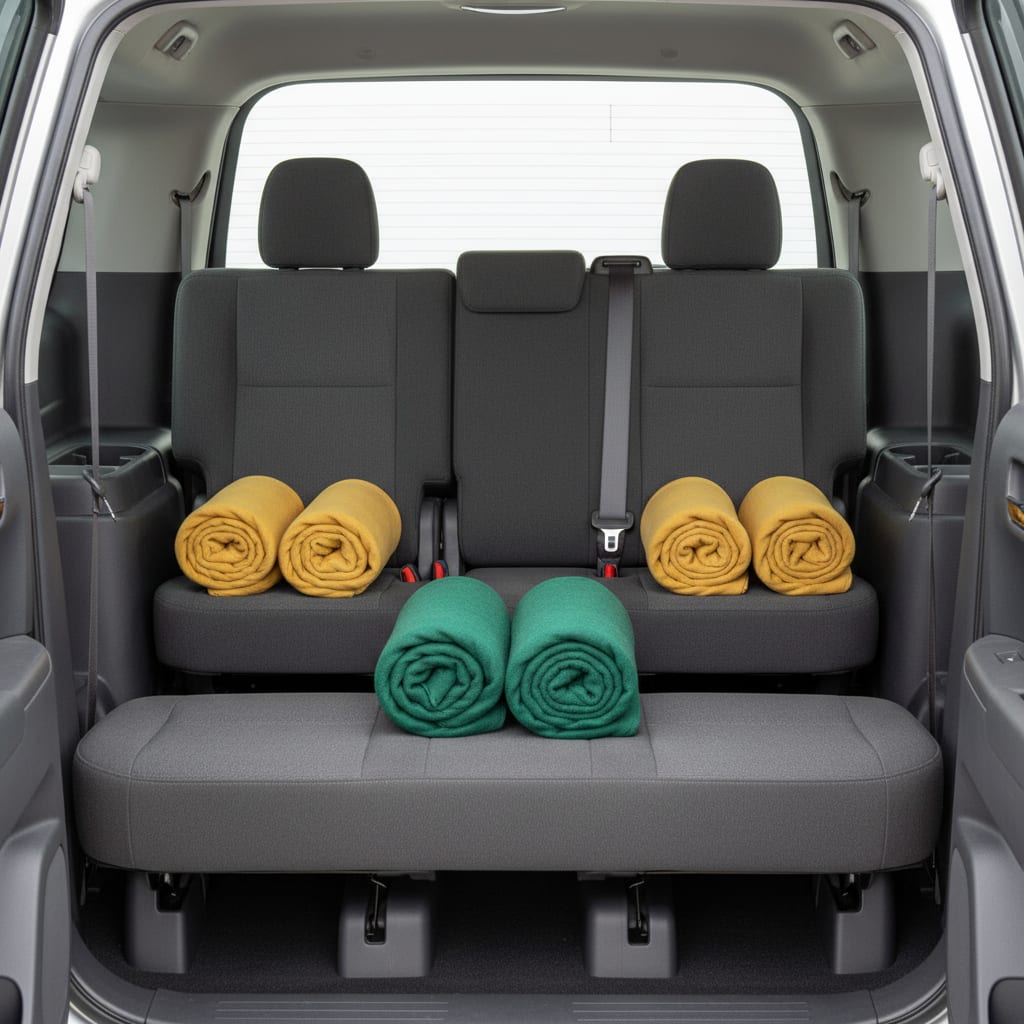
1. Row-two usable width. Not the brochure’s shoulder-room figure — the flat, seatbelt-to-seatbelt space you can install seats across. Minivan benches are typically flat and generous; three-row crossovers narrow at the hips and often have a hump or a raised middle cushion that fights a third seat. This is the number that decides whether you’re buying narrow car seats or buying a different vehicle.
2. Third-row access with the seats installed. Here’s the trap almost every SUV shopper walks into: three-row SUVs get you to row three by tilting and sliding a row-two seat forward. Install a car seat there and that motion is gone. So access depends on an aisle — and an aisle requires second-row captain’s chairs — and captain’s chairs mean row two seats two, not three. You cannot have 3-across in row two and a walk-through aisle in the same row. Minivans win here only because their sliding doors put the opening where the aisle is; the trade is the same.
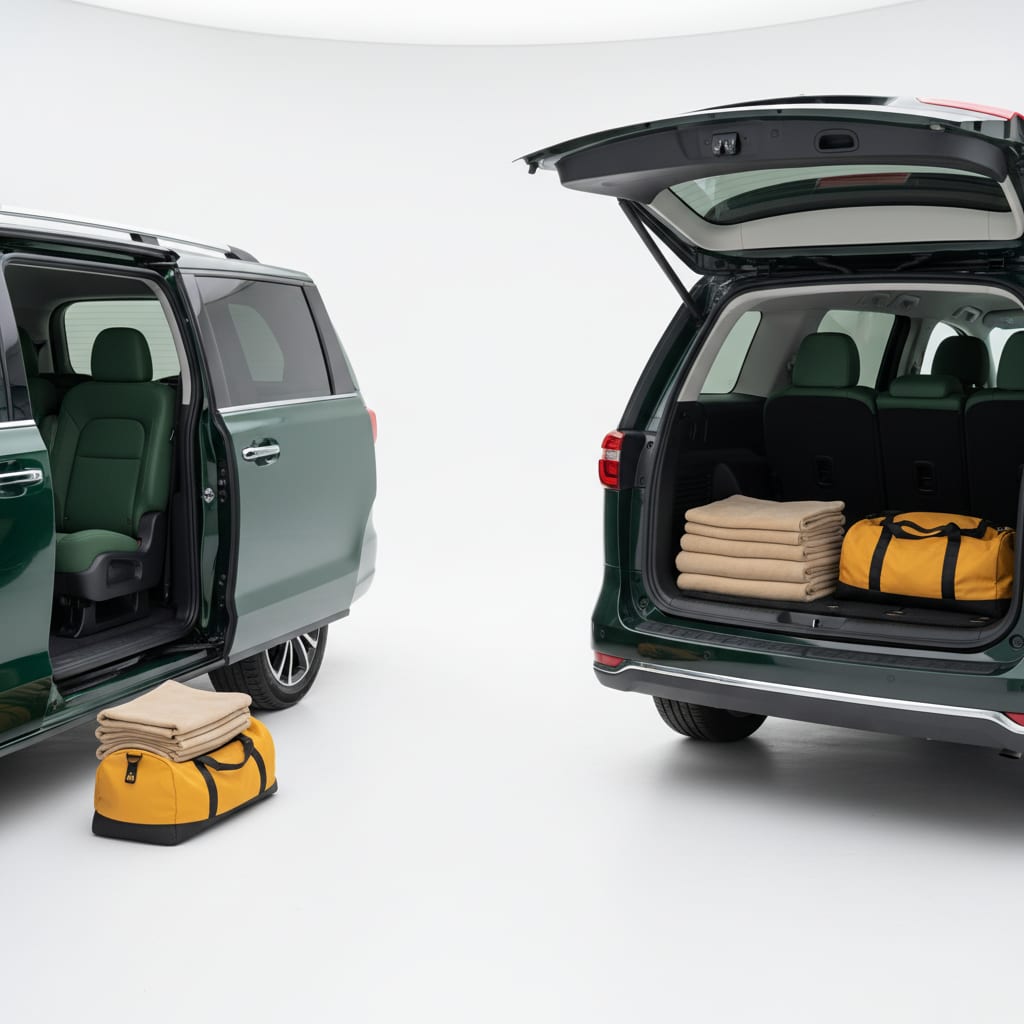
3. Cargo behind row three. With everybody seated. Minivans hide the third row in a floor well, which means the space behind it is a deep, square hole that eats a stroller and a week of groceries. Most three-row crossovers give you a shallow shelf back there — enough for backpacks, not enough for a Costco run and a double stroller. Full-size body-on-frame SUVs (the extended Suburban/Expedition class) are the exception and hold their own.
4. How many kids are still in seats. Car seats are the constraint that expires. If you’ve got three in seats today and two of them are in boosters within eighteen months, the vehicle you need in 2028 is not the vehicle you need tonight — and boosters are cheap while vehicles are not. Solve the next two years, not the next ten.
Where the minivan genuinely wins
- Sliding doors in tight parking. Not a luxury feature — a damage-prevention feature and a toddler-management feature. Kids who can’t fling a door into a Honda don’t fling a door into a Honda. In a school pickup line or a packed grocery lot, this is the single biggest daily-life difference between the two body styles.
- Low floor height. Four-year-olds climb in unassisted. In a lifted SUV they get boosted, one at a time, by you, in the rain. Multiply by however many kids you have and you’ll feel it inside a week.
- The eighth seat. Minivans commonly offer an eight-passenger configuration with a three-place second-row bench. Most three-row crossovers cap at seven or eight but with a much tighter row three. When your kid count plus one friend exceeds seven, this gets very simple very fast.
- Real cargo with all rows up. The fold-flat third row is a design advantage no crossover can copy without giving up ground clearance.
- Usually cheaper to buy at the same trim level, and cheaper again used, because the market irrationally discounts them. That is your discount to collect.
Where the SUV genuinely wins
- Weather and terrain. All-wheel drive is available on some minivans now — Sienna and Pacifica both offer it — but ground clearance isn’t, and if your driveway is gravel and your winter is real, that matters.
- Towing. Minivans generally tow modest loads (roughly 3,500 pounds is the common ceiling); a body-on-frame SUV tows multiples of that. Camper, boat, or utility trailer in the picture? The conversation is over.
- Resale and the used-market floor. Large SUVs hold value stubbornly. You pay more going in and get more coming out, so the gap is smaller than the sticker suggests.
- The one nobody says out loud: some people will not drive a minivan, and a vehicle you resent is a vehicle you replace early, which is the most expensive thing you can do. Factor it honestly rather than pretending it doesn’t count.
The comparison, line by line
| Factor | Minivan | 3-row crossover SUV | Full-size SUV |
|---|---|---|---|
| Row-two 3-across | Usually easiest — flat wide bench | Hardest — narrows at the hips | Good, often bench-optional |
| Third-row access with seats in | Sliding door + aisle (captain’s chairs) | Aisle only, and only with captain’s chairs | Aisle, wider than crossovers |
| Cargo behind row three | Deep well — the class winner | Shallow shelf | Competitive with minivans |
| Kid self-loading | Best — low floor, sliding doors | Fair | Worst — high step-in |
| Towing | Modest | Modest to fair | Strong |
| Weather/clearance | FWD or AWD, low clearance | AWD common | AWD/4WD, high clearance |
| Fuel cost | Generally lowest of the three | Middle | Highest |
| Tight-lot manners | Best | Middle | Worst |
| IIHS rear-seat result (belted older kids) | Lagging: no minivan earned a 2026 award | Varies; many 2026 award winners are SUVs | Varies by model |
Prices and figures move by model year and trim, so treat every row as a shape, not a spec sheet. Measure your candidates yourself and verify seating and towing numbers against the current manufacturer materials before you sign anything.
Minivan vs SUV safety: what the crash tests say
This is the part of the comparison that flatters the minivan least. The figures below come from the Insurance Institute for Highway Safety (IIHS), and I read them on iihs.org in October 2026.
Minivans lag on back-seat protection. In 2022 IIHS updated its moderate overlap front crash test to emphasise the back seat, adding a second dummy behind the driver that is “the size of a small woman or 12-year-old child.” When it put the four current minivans through it, none earned an acceptable or good rating: the Chrysler Pacifica, Kia Carnival and Toyota Sienna were rated marginal and the Honda Odyssey poor. IIHS said the restraints in all four “leave the second-row occupant vulnerable to chest injuries, either because of excessive belt forces or poor belt positioning.” That release is from September 2023, and IIHS has since adjusted the criteria (the Sienna’s chest-injury score moved from marginal to acceptable under the 2024 method). Check the current rating for your exact model year on iihs.org before you rely on it. The picture had not changed by March 2026. IIHS’s 2026 awards announcement says: “No minicars, minivans or small pickups earn awards this year.” SUVs of various sizes made up 35 of its 45 top-tier winners.
What that rating covers, and what it doesn’t. The rear dummy is a belted passenger without a car seat. IIHS says the rating “does not apply to children secured properly in child safety seats,” and that “the back seat remains the safest place for children.” So if every child in row two is still in a harness, this isn’t the number to worry about. In a big family it starts to matter a few years later: the 10-to-13-year-olds riding on the adult belt in row two are exactly the passenger that dummy represents.
Size and rollover pull in opposite directions. IIHS’s guidance on size and weight is that “a bigger, heavier vehicle provides better crash protection than a smaller, lighter one, assuming no other differences between them,” which favours the full-size SUV. Against that, its 2024 fatality figures say “pickups and SUVs are more likely than cars to be in fatal single-vehicle crashes, especially rollovers,” with rollovers accounting for 33% of SUV occupant deaths against 20% for cars.
How to use this when you shop. Narrow the list by your seats first, as everything above says. Then look up the current IIHS ratings for the two or three vehicles left and read the rear-passenger part of the moderate overlap result, not just whether the vehicle won an award. The rest is up to you on every drive: each child in the right seat for their size, row-two belts sitting on the shoulder rather than the neck, and children in the back seat until an adult belt fits them properly, which is how IIHS puts it.
Pick by your family shape
Three-plus kids in car seats, city or suburban driving. Minivan, and it isn’t close. You need row-two width, buckle access, and cargo, and you need all three at once. Start with the minivan seating breakdown and match it against the seats you already own.
Two in seats, one big kid, snow and a trailer. Three-row SUV. Your car-seat constraint is temporary and your terrain constraint is not.
Five-plus kids, most out of seats. Full-size SUV or a minivan, depending on whether you tow. Once car seats stop being the limiting factor, the decision becomes cargo, towing and step-in height.
Two vehicles in the household. Don’t buy two of the same shape. One hauler that takes the whole crew plus gear, one anything-else. Two mid-size crossovers means you own two vehicles and still can’t take everyone to the beach.
A “we might have another” situation. Buy for the next kid now if it’s a plan and not a maybe — the vehicle swap is the most expensive way to greet a positive test.
The mistakes that cost real money
Buying seats after the vehicle. Backwards. Your seats are the fixed dimension; the vehicle is the variable. Take your actual seats to the actual test drive and install them in the actual lot — a dealer who won’t allow that is telling you something useful. The tested list of cars that fit 3 across is a starting shortlist, not a substitute for a fitting.
Assuming eight seatbelts means eight passengers. LATCH anchor positions are not universal across every seating position, some middle positions have lap-only belts (which cannot take a booster), and third rows vary wildly in whether they’ll take a seat at all. Count usable positions for the seats you own.
Ignoring the buckle-hand test. In a 3-across row, whoever sits in the middle has to be buckled by someone. If you can’t get your hand to that buckle with the outboard seats installed, you’ve bought yourself a daily wrestling match. Test it before purchase, in the dark, with gloves on if you live somewhere cold.
Forgetting the trip case. The vehicle that’s perfect for the school run can be useless at hour six of a drive. Before you commit, walk through a real trip — cooler, luggage, everybody’s bag — and see where it goes. Our road-trip seating chart post is the in-car half of that stress test.
FAQ: minivan vs SUV for a big family
Is a minivan really better than an SUV for a big family?
For daily hauling of four-plus kids, usually yes — sliding doors, low floor, wider second row and far more cargo behind the third row. The SUV wins when towing, ground clearance or genuinely bad weather are part of your week, and full-size SUVs close the cargo gap.
Is a minivan or an SUV safer for kids?
On minivan vs SUV safety, IIHS’s recent results favour SUVs for belted back-seat passengers. No minivan earned a 2026 IIHS award, mainly because of how they protect second-row passengers. That rating does not apply to children in car seats, though, and IIHS still calls the back seat the safest place for them. Check the current rating for the exact model year.
Can you fit three car seats across in an SUV?
In some, yes — mostly full-size SUVs with a second-row bench, and a handful of crossovers with unusually flat benches. The reliable method is measuring your seats and test-fitting them, because a vehicle that fits three narrow boosters may refuse three convertibles.
How many kids do you need before you need a minivan?
It’s less about kid count than seat count and trip length. Three kids in car seats plus a stroller usually breaks a crossover; four kids of any age plus their gear almost always does. Two kids can live comfortably in nearly anything.
Do minivans come in all-wheel drive?
Some do — all-wheel drive is available on current Toyota Sienna and Chrysler Pacifica models, though availability varies by trim and powertrain, so confirm on the specific configuration you’re considering. Ground clearance stays low regardless, which is the real limit off pavement.
Is a used minivan a smart buy for a big family?
Often the best value on the lot, because the market discounts the body style rather than the vehicle. Check the sliding-door mechanisms and the third-row fold hardware — those are the parts that wear on a family van — and always test-install your own car seats before buying.