Best Minivans for Families (Large-Family Seating Audit)
The best minivan for families is the one whose seating chart works for your actual lineup of car seats — which is why this guide is built around LATCH positions, tether counts and third-row access instead of horsepower and touchscreen sizes. Any family van on this list (Honda Odyssey, Toyota Sienna, Chrysler Pacifica, Kia Carnival) hauls seven or eight people. They differ in which seven or eight, buckled into which positions, with which seats still reachable once the car seats are in. Shop the seating chart first, the badge second. Five kids ride in mine, so this is the audit I actually ran.
The audit that matters: LATCH positions and tethers
Car-review sites test vans empty. Your van will never be empty again, so audit the child-restraint layout before anything else:
- Count full LATCH positions and where they are. Vans differ in how many seating positions get complete lower-anchor sets and which rows they’re in. The authoritative source is the child-restraint section of that model year’s owner’s manual — not a sales page — and configurations shift between model years and trims, so verify the exact van in front of you.
- Count tethers separately. Lower anchors and top tether anchors are two different inventories, and they don’t always match: a row can have three tethers and two lower-anchor sets, or the reverse. Forward-facing harnessed seats need the tether, so count that row by tethers.
- Ask about anchor borrowing rules. Center-position LATCH is often “borrowed” from outboard anchors, which most manuals prohibit. If your plan involves a center install, know whether it’s a LATCH install or a seat-belt install before you buy.
- Seat-belt installs count too. A van with fewer LATCH positions but easy-to-reach buckles and solid belt lockability can beat one with more anchors buried in seat creases. Bring your actual seats to the test drive and install them — the dealership will survive it.
The seating chart, van by van
Cars.com runs a standardized Car Seat Check on new vehicles, and it reports the two things a big family needs and almost nobody else asks about: how many complete anchor and tether positions each row has, and whether the row-three walkway still works with a car seat installed. Here is what those checks recorded on a recent model year of each of the big four. Configurations move between years and trims, so read every line as “verify on the vehicle in front of you” — but the shape of each van’s compromise is stable enough to decide which two you go and drive.
| Van (model year checked) | Row 2 lower anchors | Row 2 tethers | Row 3 lower anchors | Row 3 tethers | Third-row entry |
|---|---|---|---|---|---|
| Honda Odyssey (2025) | 3 sets with the middle seat fitted | 2 | 2 sets | 3 | Grade A |
| Toyota Sienna (2021) | 3 sets | 3 | 2 sets, outboard | 3 | Grade B |
| Chrysler Pacifica (2026, Pinnacle) | 2 sets (captain’s chairs) | 2 | 2 sets | 2 | Easy fold, “manageable” step-in |
| Kia Carnival Hybrid (2025, bench) | 3 sets | 3 | 2 sets, outboard | 3 | Grade B |
Honda Odyssey. The 2025 check graded Latch, infant seat and both convertible installs at A, with second-row lower anchors “exposed for easy access and connection” and two well-labeled tether anchors. Fit the optional removable middle seat and row two carries three complete sets of lower anchors — the most generous arrangement in the class. Row three adds two exposed anchor sets and three tethers, “all easy to find and use, but only the middle one is clearly marked.” The recorded weakness is buckles: the booster grade dropped to B because “the Odyssey’s floppy buckles could be tough for kids to grasp and use independently,” and a third-row center buckle interferes with driver visibility. The Magic Slide second row moves fore, aft and sideways, which is the feature that sells this van to big families — note the check’s caveat that the easy-slide passageway “works well to open a passageway to the third row, but not with the car seat installed.”
Toyota Sienna. The 2021 check is the cleanest on paper: three sets of exposed lower anchors and three tether anchors in row two, two outboard sets plus three tethers in row three, and second-row buckles stable enough that kids work them alone. Most installs graded A; third-row entry and third-row booster both took a B. Two things to weigh. The outboard seats “collapse with a little bit of muscle, providing a wide opening to the third row, though this won’t work when a car seat is installed,” and the removable middle seat — the alternative path through — is “heavy and cumbersome to take out,” which in practice means it lives in the van or it lives in the garage forever. Third-row buckles are the weak spot: only the passenger-side one is stable, the other two sit flush with the cushion.
Chrysler Pacifica. The 2026 check tested the Pinnacle trim, which runs second-row captain’s chairs — so row two has two seating positions, two lower-anchor sets and two tethers, all easily accessible, with stable buckles fixed to the side of each chair. Row two graded A across the board. Row three is where it costs you: two anchor sets that “require a little maneuvering,” one of which spans the middle and driver-side seats, tethers that aren’t clearly marked, floppy buckles, and C grades for the forward-facing convertible and booster because fixed outer head restraints push the seats off the seatback. Access is the trade-off working in your favour — the chairs fold and slide easily with a manageable step-in.
Kia Carnival. The 2025 hybrid check tested a three-seat second-row bench and graded straight A’s — Latch, infant, both convertibles and booster. Row two has three lower-anchor sets (outboard exposed, the middle pair sitting “just within the seat bight”) and three tethers at the base of the seatback; row three has two outboard sets and three tethers running all the way down the seatback. Buckles split predictably: outboard on stable stalks, middle floppy, third row “recessed or floppy” with a middle buckle that blocks visibility in use. Third-row entry graded B — “the opening to the third row is big, but the step-in is pretty tall,” and again, not with a car seat installed. Note the Carnival also offers lounge-style second-row seating on some trims, which is the configuration to rule out for this job.
Any of the four can be the right answer. The wrong answer is buying on reviews and discovering your seat lineup doesn’t fit the LATCH map.
The access tax nobody prices in
Read those four entries together and one sentence appears in three of them: the second-row seat that slides or folds to open the third row won’t do it with a car seat installed. That is the single most consequential line in the whole category for a family running five-plus kids, and no brochure mentions it.
What it means in practice: the moment row two is full of car seats, your third-row passengers are climbing over or around, not walking through — unless the van has a genuinely open aisle, which is what a captain’s-chair second row buys and a three-across bench spends. That is the real trade. A bench maximises positions; captain’s chairs maximise access. A family with three harnessed kids and two big ones may genuinely be better off with the chairs and the aisle; a family with five little ones needs the bench and accepts the climb.
Decide which of those two you are before you walk onto the lot, because every other feature is negotiable and this one isn’t.
Ten features that actually matter in a family van
Ranked by how often they change a real day, not by how they photograph:
- Power sliding doors on both sides. The whole reason the van wins over the SUV. Test them with your hands full — that is the only realistic test.
- A second-row bench, or a middle seat that’s actually fitted. Eight belts is not eight usable positions, and the middle seat is an option on more vans than people expect.
- Tether coverage in row three. Count them. A third row with two tethers caps you at two forward-facing harnessed kids back there, whatever the seat count says.
- Stable buckle stalks. Floppy stalks lie flat under a car seat shell and disappear; independent buckling is how a seven-person load-up takes four minutes instead of twelve.
- A walk-through aisle you can still use loaded. See above. Check it with seats in, not empty.
- Step-in height to row three. Tall step-ins are a daily tax on the kid who rides back there and on whoever buckles them.
- Rear climate control with its own vents in row three. A back row that’s ten degrees off is a back row nobody will sit in.
- Low, flat cargo floor behind row three. The groceries for a household of seven have to go somewhere that isn’t a lap.
- Wipe-clean surfaces and removable floor mats. You will be cleaning this vehicle more often than you drive it far.
- Enough USB ports for the actual headcount. Trivial-sounding, genuinely load-bearing on a four-hour drive with five kids.
Notice what isn’t on the list: horsepower, trim badges and screen size. None of them has ever decided whether we got out of the house on time.
Fit your seats before you fit the van
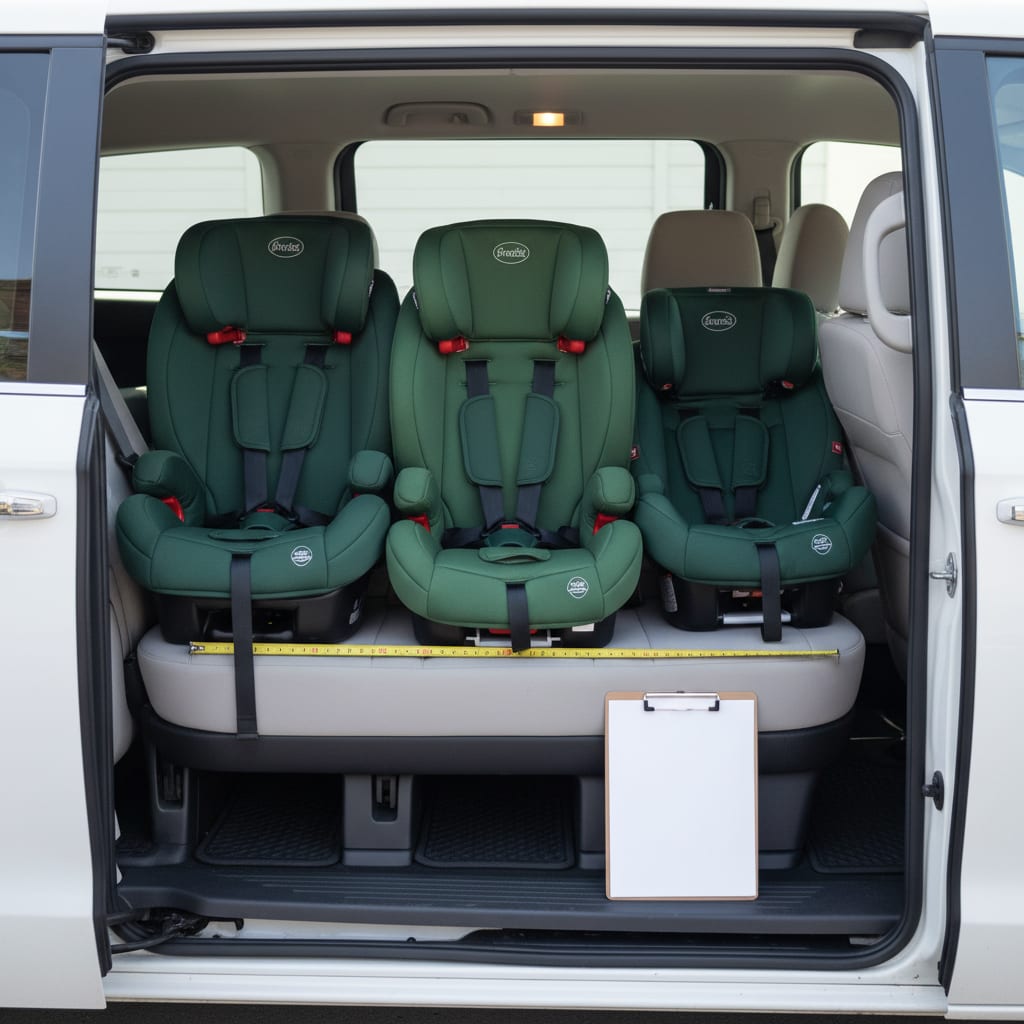
The van is the expensive half of a two-part puzzle; the seats are the cheap half. Before you spend van money, know your current seats’ widths and whether slimmer gear solves it — a roughly 17-inch-wide seat class exists, and slim boosters buy back bench inches cheaply once kids graduate from harnesses.
If your question is specifically which vehicles fit three car seats across a single row, that is a different question from this one and it has its own answer: the method, the per-vehicle bench findings and the 20-minute dealership test all live in our tested three-across list. Some five-seat vehicles swallow three seats and save you the entire upgrade, which is worth knowing before you finance a van. And if the third row is where your little ones are going to ride, read what actually fits back there first — row three is the row people buy for and never audit.
Buying used? Same audit, plus: pull every LATCH anchor cover and check for rust or damage, confirm no seating position’s airbag or belt has open recalls, and remember that older model years may have different LATCH layouts than current-year reviews describe.
FAQ: family minivans for large families
Which minivan seats eight?
All four mainstream family vans offer eight-passenger configurations on at least some trims, usually via a second-row middle seat — but trim and model year decide it, and eight belts is not the same as eight usable positions once car seats land. Verify the specific vehicle’s configuration and LATCH map.
Which minivan has the most LATCH positions?
On the checks above, the Odyssey with its removable middle seat fitted and the Sienna and Carnival benches all reach three complete lower-anchor sets in row two, with two more outboard sets in row three. A Pacifica on captain’s chairs has two in row two by configuration. Count tethers separately — that number is usually the binding one.
How many car seats fit in a minivan?
More than in almost anything else, which is why big families keep buying them — sliding doors, real third-row access and multiple tether positions. The practical limit is set by anchor placement and seat widths, not floor space.
Minivan or big SUV for a large family?
If the mission is daily kid-hauling, the family van usually wins on doors alone — sliding doors in tight parking lots with a kid on your hip settle the argument. Big SUVs win on towing and image. Run your own seating audit on both before paying the SUV premium.
Should I buy the van before or after the car seats?
Audit what you own first. If your current vehicle fails only by an inch or two, slimmer seats are a far cheaper fix than a van payment. If you’re genuinely out of belts — headcount exceeds positions — then buy the van, and bring every seat you own to the test drive.