Cars That Fit 3 Car Seats Across: The Tested List
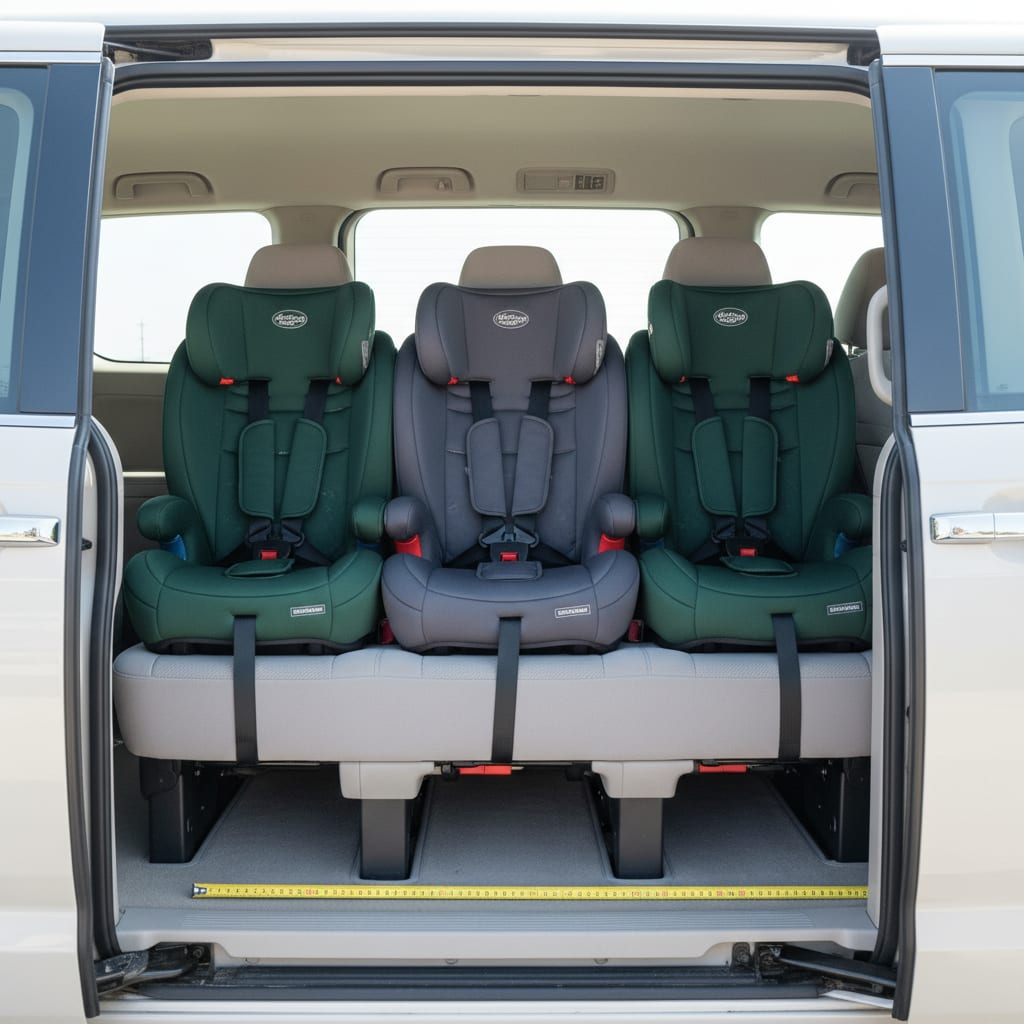
The vehicles most likely to fit three car seats across are minivans first (Chrysler Pacifica, Honda Odyssey, Toyota Sienna, Kia Carnival), full-size SUVs second (Suburban, Expedition class), and wide three-row midsize SUVs third — but no list, including this one, replaces testing your actual three seats in the actual second row before money changes hands. Three-across is decided by inches of usable bench, buckle placement, and which car seats you own, and those interact in ways a spec sheet doesn’t capture. Here’s the honest hierarchy, the per-vehicle detail that decides it, and the 20-minute test that settles it.
Why there’s no universal list
Two families, same vehicle, opposite verdicts — because one runs three slim convertibles and the other has an infant bucket with a wide base in the mix. “Rear seat width” as published includes sculpted plastic and armrest zones a car seat can’t use; what matters is flat, usable cushion width and where the buckle stalks sit. A bench with buckles on long floppy stalks can lose a fit that a narrower bench with recessed buckles wins. This is why the method below outranks any ranking — mine included.
The second thing a spec sheet hides is trim. The same badge, same model year, will and won’t do three-across depending on whether the second row is a bench or a pair of captain’s chairs — and on some vans the captain’s-chair version is the one the dealer has on the lot. Cars.com’s standardized Car Seat Check answered “does it fit three?” with a flat no for a 2026 Pacifica on captain’s chairs and a flat yes for a 2021 Sienna, but only when the middle seat is installed. Same question, same class of vehicle, answer set by one removable cushion.
The hierarchy at a glance
| Class | Three-across in row 2 | What decides it | The trap |
|---|---|---|---|
| Minivan, 8-seat bench | Usually yes | Whether the middle cushion is fitted, and how wide it is | The 7-seat captain’s-chair trim of the same van is a no |
| Full-size SUV, bench | Usually yes | Bench width; buckle stalk type | Third rows in this class can have no lower anchors at all |
| Full-size SUV, captain’s chairs | No | Nothing — there are only two seats | Marketed on passenger count, not positions |
| Wide midsize three-row | Case by case | Slim seats plus buckle clearance | Middle position often lost to buckle overlap |
| Sedan / compact SUV | Possible, tight | Three genuinely narrow seats and patience | Middle-seat buckle war |
Read the second column as “with your seats”, not “in principle”. The classes rank in that order every time; the individual vehicle is still an open question until you install.
The hierarchy, from a family that’s run all three
Minivans are the correct answer. I resisted for two kids’ worth of years, so say it with confidence: nothing else combines a genuinely wide, flat second row, sliding doors (which matter enormously when loading three kids in a parking lot), and eight-seat configurations that give you legal spillover into the third row. If your resistance is aesthetic, I understand, and also: sliding doors.
Full-size SUVs work, at a cost. Suburban/Yukon/Expedition-class benches are wide enough that three-across is usually routine. The costs are height (loading a toddler into a third row you can’t reach from the ground), fuel, and price. If you tow or haul, it’s your category; if you don’t, you’re buying a lot of truck to get a bench. (Looking for three seats across the front row instead? That’s a different question, answered on our vehicles that seat 9 shortlist.)
Midsize three-rows are case-by-case. This class is where careful puzzling with narrow car seats makes or breaks it. Some benches in this class fit three slim seats cleanly; others lose the middle position to buckle overlap. Test, don’t assume.
Sedans and small SUVs: possible, tight. Three-across in a compact bench is a specialist move requiring genuinely narrow seats and patience. It can absolutely be done — the full puzzling method is in our 3-across combo guide — but if you’re vehicle-shopping anyway, buy bench width instead of fighting for it.
Van by van: what the standardized checks actually found
These are the four vans a big family shortlists, with the specific anchor and buckle findings from Cars.com’s Car Seat Check on a recent model year of each. Configurations move between years and trims, so treat every line as “verify on the vehicle in front of you” — but the shape of each van’s problem is stable across generations, and that’s what’s useful when you’re deciding which two to go and drive.
Honda Odyssey. The 2025 check graded the Latch system, infant seat, and both convertible installs at A, with second-row lower anchors “exposed for easy access and connection” and tether anchors that are well labeled. With the removable middle seat fitted, that’s three complete sets of lower anchors in row two — the most generous arrangement in the class. The third row has two sets of lower anchors, also exposed, and three tethers. The recorded weakness is buckles: testers called them floppy in both the second and third rows, and flagged a middle third-row buckle that drops from the ceiling and blocks the driver’s view when in use. Floppy buckles are exactly the failure mode a three-across install surfaces — the seats go in and then nobody can fish the middle buckle out from under a car seat shell.
Toyota Sienna. The 2021 check is the cleanest of the four on paper: three sets of exposed lower anchors in the second row, three clearly-marked tethers halfway down the seatback, two exposed lower-anchor sets plus three marked tethers in the third row, and second-row buckles on stable bases that a kid can work alone. Verdict on three car seats: yes, when the middle seat is installed — which is the whole ballgame, because that seat is an option, not a given. Third-row buckles are the weak spot; only the passenger-side one is stable, the other two sit flush with the cushion.
Chrysler Pacifica. Two separate things to know. On the 2026 check, the Pinnacle trim tested runs captain’s chairs and therefore does not fit three across in the second row, with two sets of easily-accessible lower anchors and stable buckles fixed to those chairs; the third row’s anchor placement is odd enough that one set spans the middle and driver-side seats and installation “required some work”, and third-row buckles are floppy. Separately, The Car Seat Lady’s write-up of the 2017–2020 Pacifica documents the eight-seater as having five tether anchors and four usable lower-anchor positions, notes that the second-row centre seat is “very narrow” — narrow enough that most car seats installed there stop the outboard seats tilting forward for third-row access — and flags the one thing nobody tells you at the dealership: because Stow ‘n Go folds the second-row seats into a hollow floor, you cannot use a load leg in any second-row seat. If your infant seat’s base has a load leg, that single sentence may decide your van.
Kia Carnival. The 2025 hybrid check fitted three car seats in a three-seat second-row bench, with A grades across Latch, infant, both convertibles and booster. Three sets of lower anchors in row two: the outboard pair clearly marked and easy, the middle set sitting just inside the seat bight and unmarked. Buckles split the same way — outboard on stable stalks, the middle one floppy. Third row is the compromise: two lower-anchor sets that sink into upholstery pockets and need some muscle, positioned so close to the middle spot’s buckle that installing a car seat next to it takes the middle seat out of service, and tethers you have to dig for. Note the Carnival also comes with lounge-style second-row seating on some trims, which is the configuration to avoid entirely for this job.
Full-size SUVs: check the third row before you celebrate the second
The SUV version of the trim trap is worse, because the marketing counts seats and you need positions. The 2021 Suburban check tested a captain’s-chair model and answered “does it fit three car seats?” with a straight no, while noting that bench versions may. Second-row lower anchors were exposed and easy on the captain’s chairs, tethers clearly marked — and the second row’s floppy buckles were called out as a problem for kids buckling themselves.
The finding worth carrying into the showroom, though, is the third row: no lower anchors at all, three top tether anchors only. That is not a defect, it’s a design choice you have to plan around — a forward-facing harnessed seat back there installs with the seat belt plus the tether, which is perfectly correct, and a rear-facing seat back there may simply not be an option. For a family whose whole reason for buying the big SUV is “we’ll put the little ones in row three”, that single line changes the seating chart.
The four variables that actually decide a fit
Everything above reduces to four things, and none of them is on the window sticker.
- Usable cushion width, not published rear seat width. Sculpted bolsters, armrest housings and the fold-down centre console eat inches that the brochure counts. Measure the flat part.
- Buckle stalk type. Stable-base buckles stand up and stay findable with shells either side of them. Floppy stalks lie down under a car seat and vanish. Three of the five vehicles above have this recorded as their main weakness, which tells you how common it is.
- Interference between adjacent seats. A fit that blocks the outboard seat from tilting forward has cost you third-row access, which in a big family is a genuine functional loss rather than a nitpick. The Pacifica’s narrow centre seat is the documented case.
- Floor and base compatibility. Load legs need solid floor. Stow ‘n Go floors are hollow. Some seats’ anti-rebound bars foul a seatback at certain recline angles. These are yes/no facts about your exact base and that exact van.
The 20-minute dealership test
Bring your actual seats — all three, not a mental model of them.
- Install the middle seat first. The middle position is the constraint; do the hard one while you’re fresh.
- Outboards next, tightest configuration you’d actually run. Rear-facing where applicable — rear-facing shells claim more fore-aft room and can collide with front-seat positions.
- Buckle everything, twice. The failure mode isn’t fitting the seats — it’s whether an adult hand can reach every buckle with all three installed. If you need a hair-clip to prop a buckle up, that’s a no.
- Tilt the outboard seat forward with everything installed. If the third row is now unreachable, you have a five-seater with extra chairs in it.
- Check the front seats. Can the driver and passenger sit where they actually sit? A “fit” that requires the front passenger to ride with knees at chin height fails the six-month test.
- Load-test the doors. Close both doors fully. Sounds obvious; skipping it isn’t rare.
If a salesperson looks at you strangely, hold the line. Twenty minutes in the lot beats discovering the truth on a highway on-ramp with everyone already buckled.
LATCH reality in a three-across row
Most benches put lower anchors at the two outboard positions only, which means the middle seat typically installs with the seat belt — a properly done belt install is just as safe, and often more compatible with tight three-across fits. Don’t “borrow” one anchor from each outboard set for a center install unless your vehicle manual and car seat manual both explicitly allow it; most don’t. The manuals are boring and they win every argument.
Two corollaries the checks above make concrete. First, a dedicated centre lower-anchor set is a real differentiator — the Sienna, the Carnival’s bench and the Odyssey with its middle seat fitted all have one, and it removes the fiddliest belt install in the vehicle. Second, lower anchors and tether anchors are separate inventories, and the tether count is the one big families run short on. Count tethers for every position you plan to put a forward-facing harnessed seat in before you count anything else; the rules for the row nobody checks are in third-row car seat rules.
If the audit above has you leaning van, the seating-chart-first version of that shopping trip is best minivans for large families.
FAQ: cars and 3-across fits
What’s the cheapest car that fits 3 car seats across?
Used minivans are consistently the best value per inch of usable bench — an older Odyssey or Sienna generation offers the same fundamental geometry that makes new ones work. Test your specific seats in the specific used vehicle; benches change between generations.
Do I need a third row if I have three kids in seats?
Not strictly — three-across in one row is the entire point — but a third row is what keeps a carpool, a grandparent, or kid number four from forcing a vehicle change. Big-family rule: buy one seat more than today’s roster.
Does every minivan fit three car seats across?
No, and this is the single most expensive assumption in the category. A van configured with second-row captain’s chairs has two seats in that row, so three-across is arithmetically impossible regardless of how wide the van is. Check whether the specific vehicle has a second-row bench or a fitted middle seat before anything else.
Can any sedan fit three car seats?
Some can, with three genuinely slim seats and a methodical install. Wide-body sedans are the plausible ones; compact cars are a stretch that usually ends in a middle-seat buckle war. If it’s your current car, try the puzzle before you surrender to a bigger payment.
Is the front passenger seat an option for the third car seat?
Back seat is the standard guidance for children, full stop. Treat the front-seat question as a car seat manual and vehicle manual question, not a convenience question — and if you’re at the point of asking it, you’re at the point of testing a wider bench.
Why does the middle seat matter so much?
Because it’s the only position whose fit depends on both neighbours. An outboard seat has a door on one side and is judged alone; the middle one has to clear two shells, keep its buckle reachable, and not block the seats either side from moving. Install it first, and if it fails, nothing else you try will rescue the row.