3 Across Car Seats: Combos That Actually Fit
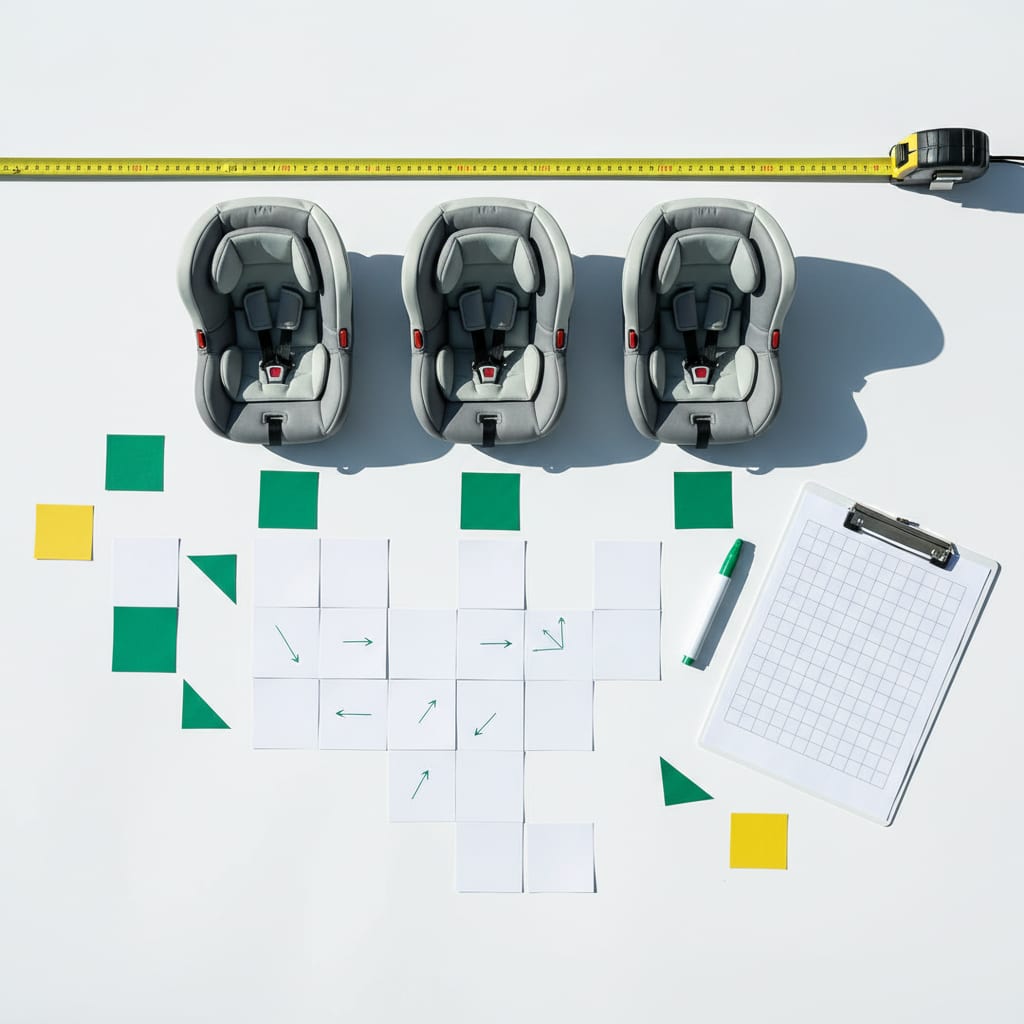
Three car seats fit across one bench when the combined width of the three seats — measured at their widest points, at the heights where they actually touch — is less than your usable bench width, with enough clearance left to buckle every seat. In practice that means most benches need at least one genuinely narrow seat (around 17 inches, like the Diono Radian 3R) in the mix, the widest seat in the middle or the narrowest, depending on your buckles, and a specific installation order. This is a solvable puzzle; I solve it every time we travel and re-solve it every growth spurt. Here’s the method.
Step one: measure what you actually have
Forget published “rear shoulder width” — measure the flat, usable cushion between the door armrest intrusions with a tape measure. Then measure your seats, or shortlist from our measured narrow-seat list: manufacturer width specs are usually the widest point, but where that widest point sits matters. Two seats that are wide at different heights can overlap like puzzle pieces; two seats wide at the same height fight for the same air.
Three quick truths that decide most puzzles:
- Width at the belt path beats width at the cupholders. Cupholders on many seats are removable; flared bases are not.
- Rear-facing and forward-facing seats stack differently. A rear-facing shell leans into the bench and is often narrower at contact height than its spec suggests.
- The buckle stalks are the real opponents. Most “it doesn’t fit” verdicts are actually “I can’t reach the buckle” verdicts.
Before the combo: map what each position is wired for
Width is only half the audit. Before you pick a combo, write down what each of the three positions actually offers, because a seat can fit across the bench and still be wrong for the spot you squeezed it into. Three things to check per position, from your vehicle owner’s manual:
- Lower anchors. The AAP’s car seat guide for families notes that “many vehicles do not have lower anchors for the middle seating position” — so the middle seat is usually a seat-belt install.
- A tether anchor. The same guide says “the top tether should always be used with a forward-facing seat, whether you use the seat belt or lower anchors to secure it.” A forward-facing harnessed seat belongs only where there’s a tether anchor behind it.
- The belt type. Some older vehicles have a lap-only belt in the middle. The AAP is blunt that lap belts “can never be used with a booster seat” — so a booster can’t go there, however well it fits.
Your plan has to satisfy all three before width comes into it. If the map rules out every shape below, the AAP points you to a child passenger safety technician (CPST), who “can help you decide which place is best to install your child’s car safety seat in your vehicle.”
Step two: choose the combo shape
After years of running combos for twins plus a toddler, the shapes that work, in order of reliability:
- Slim–slim–slim. Three narrow convertibles. Boring, effective, most expensive if you’re starting from zero.
- Slim–wide–slim. Your existing wide seat lives in the middle, flanked by two narrow seats. Works when the center buckles are recessed; fails when the middle seat’s base buries them.
- Wide–slim–slim with a booster outboard. Once your oldest hits high-back booster age, boosters are typically narrower and belt-routed, freeing precious inches. Kid ages, not just seat widths, are variables in this puzzle.
- Bucket in the mix. Infant buckets are deceptively wide at the carry-handle level. Put the bucket outboard — middle-position buckets tend to block both neighbors’ buckles at once.
Step three: install in the right order
Order changes outcomes. Middle seat first, always — it’s the constraint, and it needs your full leverage before the outboards box it in. Then the rear-facing outboard, then the easiest seat last. Buckle-check after each install, not at the end: discovering a buried buckle at seat three means redoing one seat, not three.
Two techniques that rescue borderline fits: install the middle seat a click off-center if the belt geometry allows (a half-inch shift can free a buckle), and check whether your seats permit removing cupholders — several narrow-seat manufacturers design them to come off exactly for this reason. What is not a technique: forcing a seat in with your knee until the frame flexes. Tight is good; deformed is a safety problem.
When the bench simply loses
If three configurations fail on buckle access, believe the bench. Options, cheapest first: swap one seat for a narrower one (usually the cheapest fix per inch gained), move the eldest to the third row if you have one, or accept that this vehicle is done and read our list of cars that fit 3 car seats before the next purchase. A few hundred dollars of narrow seat is cheaper than a vehicle payment — run that math before dealership math.
FAQ: 3 across car seats
What’s the minimum bench width for 3 across?
There’s no single number, because usable width and buckle placement vary — but as rough math, three slim seats around 17 inches each need somewhere around 51 usable inches plus buckle clearance. Many midsize benches sit near that line, which is why measuring beats guessing.
Does the middle seat have to use the seat belt?
Usually yes — most vehicles put lower anchors only at the outboard positions, and borrowing anchors across positions is prohibited unless both manuals explicitly allow it. A tight seat belt install is equally safe and often puzzles better in a three-across row.
Can I put the oldest kid’s booster in the middle?
Only if that position has a lap-and-shoulder belt (the AAP says booster seats “must be used with lap and shoulder belts”) and an adult can still buckle it there. Boosters need the child or an adult to buckle the belt every ride, and a buried middle buckle turns every departure into surgery. Most three-across rows run the booster outboard next to the door for exactly this reason.
Do seat protectors or mats affect 3-across fits?
They can add width and interfere with tight installs, and some car seat manufacturers prohibit them. In a three-across row you have no inches to donate to a mat — check your seat’s manual and when in doubt, skip it.