Road Trips With 4+ Kids: Seating Charts & Sanity
A road trip with four or more kids is won before you leave the driveway, by three decisions: the seating chart (who sits where, and why), the rotation rule (how seats change at stops so nobody owns the good one), and the stop cadence (when you pull over, on a schedule, not on demand). Get those right and the drive is boring, which is the goal. Get them wrong and you spend eight hours refereeing from the front seat. This is in-car operations only — where kids go, what they can reach, how the day is sequenced — tested on a five-kid crew and a lot of interstate. The vehicle itself (tire pressure, the spare, the load limit on the door sticker) gets its own pass in our road trip car checklist.
Build the seating chart before you pack
A seating chart isn’t about fairness. It’s about who needs reaching, who needs separating, and who’s asleep.
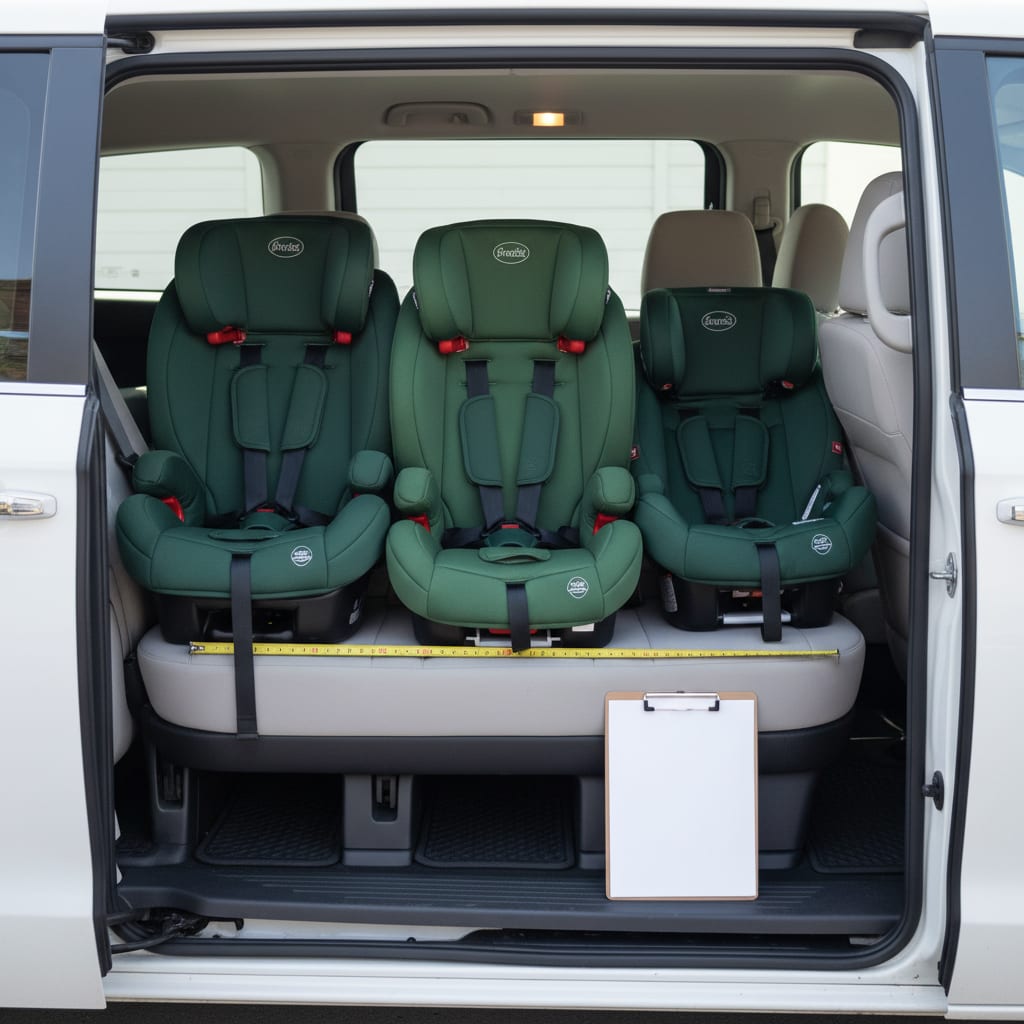
- Buckle access first. Anyone you have to buckle personally goes where your arms actually reach — usually outboard, near a door. A kid you buckle from a full-body lunge across two seats is a kid who makes every stop three minutes longer. This is the same principle that drives 3-across seat placement at home.
- Separate the combatants. Every crew has one pair that cannot share a border. Put a third kid, an aisle, or a row between them. This is not a character judgment; it’s traffic engineering.
- Sleepers get the shade side and a headrest. Whoever reliably sleeps in the car should be somewhere their head has support and the afternoon sun isn’t in it. High-back boosters help here more than backless ones — one reason mixed booster setups exist, per the slim booster rundown.
- Reachable kids in row two, self-sufficient kids in row three. Row three is for kids who can open their own snacks, manage their own screen, and refrain from unbuckling. Not the youngest — the most independent.
- Nobody sits behind the driver if they kick. Ask me how I learned.
Write the chart down and post it on the fridge the night before. Kids argue with parents; they argue less with a posted chart.
The rotation rule: fairness on a timer
The window seat is a currency. Rotate it at every fuel stop, one position clockwise, no negotiation, no exceptions, no re-litigating at hour five. Two things make it work: the rotation is announced before departure (not invented mid-trip when someone complains), and car-seat kids are exempt for the obvious reason — their positions are fixed by fit and by buckle access. Exempting them openly at the start kills the “that’s not fair” cycle before it starts. Kids accept an unfair-looking rule they were told about in advance far more readily than a fair-looking one improvised under pressure.
Stop cadence: pull over on the clock
Stopping when someone complains teaches everyone that complaining produces stops. Stop on a schedule instead:
- Every two to two and a half hours, whether or not anyone has asked.
- Ten minutes minimum, and everybody gets out — including the kid who says they don’t need to. Especially that kid.
- Bathroom, then run, then reload. Not the reverse; a kid who’s just been handed a snack won’t run.
- Announce the next stop time when you pull back on. “Next stop is 11:40” ends roughly ninety percent of the how-much-longer traffic.
- One long stop beats three short ones. A real 30-minute park stop at the midpoint resets the whole vehicle better than three gas-station shuffles.
If you’re driving with a baby or toddler in the mix, sequence the driving around their sleep rather than fighting it: leave right before a nap window so the first leg is quiet, and expect the schedule to be the thing that breaks first. If you don’t know what today’s window even is, Betteroo’s wake-window guide by age gives you the shape to plan against.
The per-kid bag, and why one shared bin fails
One communal activity bin creates a communal argument. Instead: one bag per kid, packed by that kid within limits you set, kept at their feet — not in the trunk, where it may as well be at home.
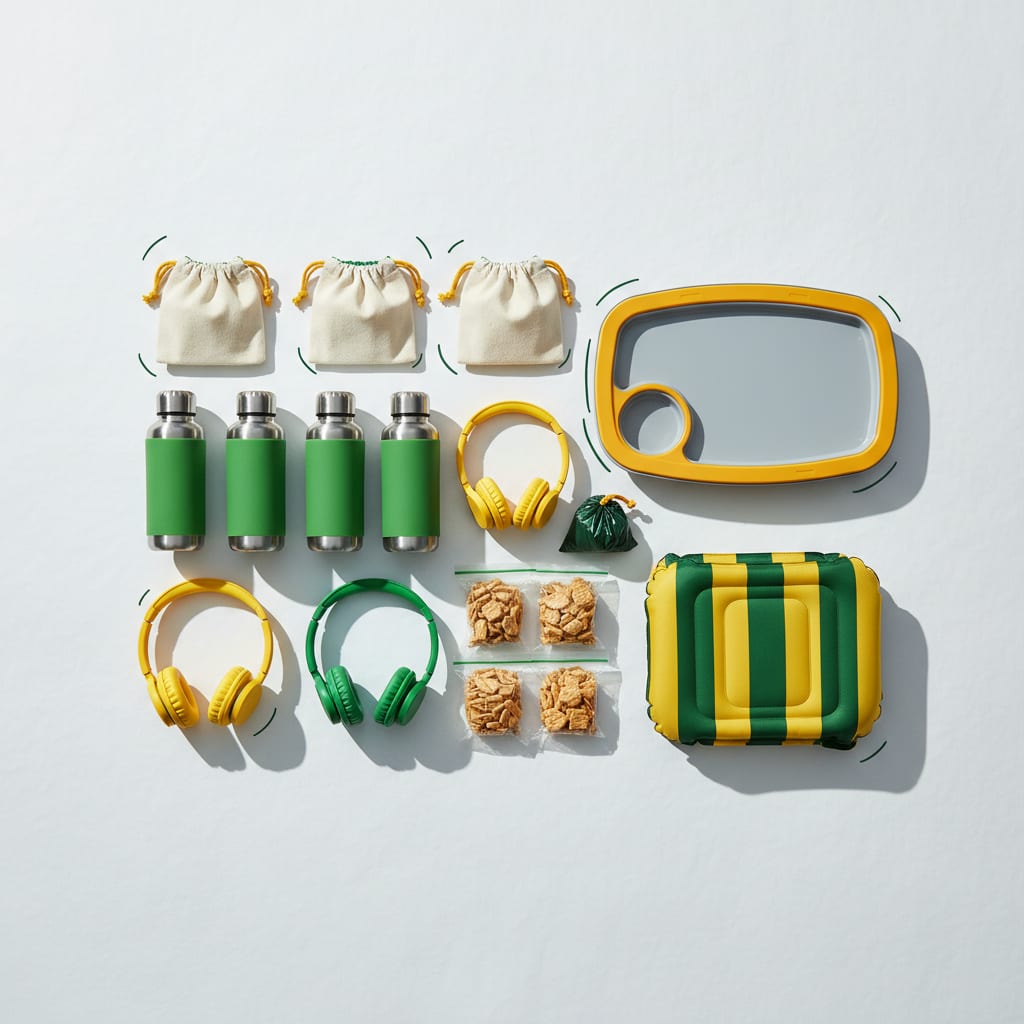
What’s in ours: two quiet activities, one comfort item, a refillable water bottle, headphones, and a hoodie that doubles as a pillow. What’s not: anything with small pieces that roll, anything that makes noise without headphones, and anything they’ll finish in twenty minutes and then mourn.
A lap tray converts an unusable lap into a work surface — a Lusso Gear car seat travel tray is the workhorse version, with a raised edge that keeps crayons from becoming floor crayons. And if your trip involves a rental car or a swap into grandma’s sedan, a compact inflatable booster like the BubbleBum packs flat in a duffel and saves you renting a mystery seat at the counter.
Food, trash and the smell problem
Feed on your terms or the vehicle will decide for you. Our rules, in order of how much grief they’ve saved:
- Snacks are portioned before departure, one labeled bag per kid per leg. Nobody negotiates with the front seat over goldfish.
- No red drinks, no yogurt, no anything that requires a spoon. Water and dry food. This is not fussiness; it’s upholstery.
- A trash bag lives on the floor of each row, and it gets emptied at every single stop. A car with four kids generates trash at a rate that will genuinely surprise you.
- Real food at real stops. Eating a proper meal outside the vehicle at the midpoint stop keeps everyone from grazing continuously and hitting the destination sugar-wrecked.
Screens, noise, and the volume floor
Headphones are non-optional in a full vehicle — four devices on speaker is not a road trip, it’s a cockpit failure. Set a screen policy before departure and state it in hours, not shows: screens after the first stop, off for the last hour, audio for everyone in between. A shared audiobook is the sleeper hit of multi-kid driving, because it’s the only entertainment that works for a seven-year-old and an eleven-year-old at once, and it makes the whole car quiet without anyone being told to be quiet.
For the last hour, go analog on purpose. Kids arrive at a destination better when they’ve been out of a screen for a while, and unloading a vehicle full of glazed-over children is its own special task.
When the plan falls apart
It will, usually around hour five. The recovery play is always the same: stop early, get everyone out, let the drive run long. Arriving late and intact beats arriving on time and shattered. And if the vehicle itself is the problem — nobody can reach a buckle, the cargo won’t fit, row three is a punishment — that’s not a trip problem, it’s a vehicle problem, and the minivan-versus-SUV math is where that conversation belongs.
FAQ: road trips with four or more kids
How often should you stop on a road trip with kids?
Every two to two and a half hours, on a schedule, for at least ten minutes, with everyone out of the vehicle. Scheduled stops beat demand-driven stops because they remove the incentive to complain and let you plan mileage honestly.
What is the best seating arrangement for a car full of kids?
Buckle access first, combatants separated, sleepers on the shade side with head support, and the most independent kids in the third row. Post the chart the night before so the argument happens at home, not at 70 miles an hour.
How do you keep kids entertained on a long drive without screens?
A shared audiobook is the highest-yield option for mixed ages, backed by per-kid activity bags packed the night before, window games with a defined end, and a lap tray so drawing is actually possible. Rotate activities at stops rather than letting kids burn through everything in the first hour.
Should you drive overnight with young kids?
It’s tempting and it works for some families, but it front-loads the risk onto the driver — the person who cannot nap at the next stop. If you try it, split the driving with a second adult and treat the following day as a rest day rather than a schedule day.