Bedtime When the Whole Family Shares One Bedroom

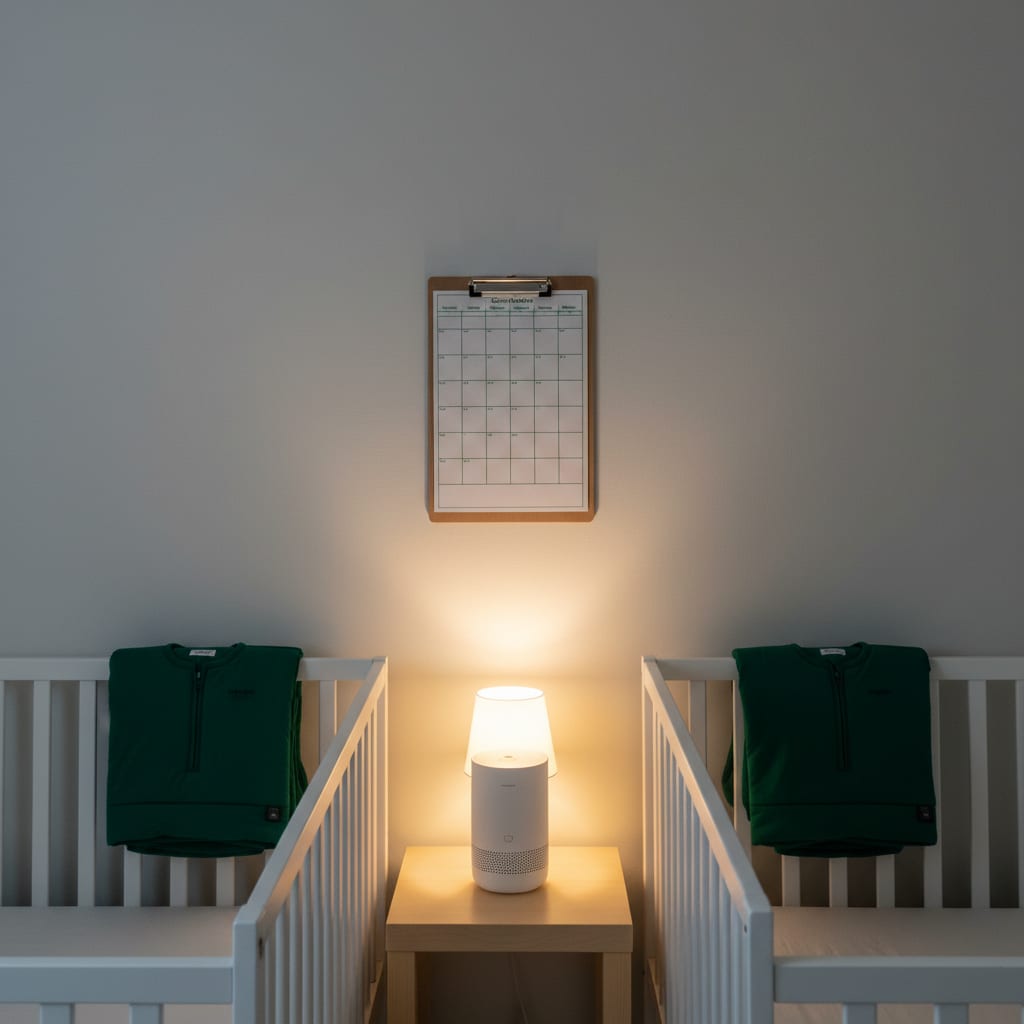
When the whole family sleeps in one bedroom, you can’t stagger bedtimes by sending people to different rooms — so you stagger light, sound and sightlines instead. Zone the floor by who can see whom from their pillow. Give the baby their own flat, firm surface next to an adult bed. Then put people down in the order of who wakes whom, run the older kids’ wind-down somewhere outside the room, and have the adults arrive last, in the dark, with everything they need already inside. One light, one sound floor, no new inputs after the sequence starts.
Zone the room before you argue about bedtimes
The first fix is a floor plan, not a schedule. Stand in the doorway and ask one question per sleeper: from their pillow, what can they see? Sightline is the variable in a shared room, not square footage — two kids who can see each other will talk to each other for forty-five minutes on a school night.
So break the sightlines: a curtain on a tension rod, the back of a low shelf unit, the foot of the adult bed turned ninety degrees — anything that makes the six-year-old’s field of view a wall instead of her brother’s face. Company is what you’re removing; sound travels regardless.
Then assign positions by three rules, in order:
- The lightest sleeper gets the corner furthest from the door. Every night trip passes the door, so put the hardest kid to re-settle at the end of that route, not the start.
- Nobody sleeps in the walking lane. Map the real path from door to bed to closet at 11pm in the dark, and keep every mattress and rail out of it.
- The earliest sleeper gets the darkest wall. Away from the window, the switch, and the gap under the door.
Fitting three or more sleeping spots into one room? Measure first — the clearance method in my three-kids-one-bedroom layouts works the same when two sleepers are adults.
The baby’s own surface is the one thing that isn’t negotiable
Everything else here is logistics you can tune. This part isn’t.
The American Academy of Pediatrics’ parent guide to safe sleep is direct: room share, don’t bed share. Put the baby’s crib, bassinet, portable crib or play yard in your bedroom, close to your bed, for at least the first six months — which is the arrangement a one-bedroom household is already in. The surface has to be firm enough not to indent under the baby, and flat; the guidance draws the line at anything inclining more than 10 degrees. Bed sharing isn’t recommended under any circumstances, and that includes twins and other multiples, so two babies means two surfaces.
The other line from that page I’d tattoo on a wall: the risk of sleep-related infant death is up to 67 times higher when an infant sleeps with someone on a couch, soft armchair or cushion. In a one-room house the 3am temptation isn’t the bed, it’s the chair — feeding sitting up, both of you going under. Feed somewhere you will not fall asleep, and put the baby back on their own surface.
Where there’s no floor to spare, a play yard with a full-size bassinet level does a crib’s job and folds away — the Graco Pack ‘n Play On the Go is the workhorse version. And no, a sibling doesn’t get to share a surface with the baby, however sweet the offer.
If the bassinet is where the wheels come off, Betteroo’s guide to a baby who won’t settle in the bassinet is worth a read — most of it is fixable without new furniture.
Put people down in the order of who wakes whom
You are not running one bedtime for five people. You’re running a sequence in a room that holds one bedtime at a time, ordered by re-settle cost: whoever is hardest to put back down goes first, into the quietest window of the night.
For most crews that’s baby, little kid, big kid, adults. What makes it work is that only the sleeping happens in the room. From the moment the first person is down, that door is a one-way valve — pyjamas, teeth, stories, the glass of water and the last three questions about sharks all happen somewhere else: the kitchen table, the hallway floor, the bathroom.
That’s the staggered system for kids sharing a room with the runway moved outside the walls. A rough shape, in offsets rather than clock times:
| Time | Who | Where |
|---|---|---|
| T-45 | Everyone | Baths, pyjamas, teeth — outside the room |
| T-20 | Baby | Room, low light, feed and down |
| T-10 | Little kid | Walked in already asleep-ready, no talking |
| T+15 | Big kid | Reads in the hallway, then goes in dark |
| T+60 | Adults | One silent trip, nothing new turned on |
Tell the big kid the later slot is a privilege, because it is: the currency you have to spend in a one-room house is time alone with a parent.
One light, one sound floor, nothing new after that
Set the light once: one warm low lamp aimed at a wall, on before the first sleeper goes down, off when the last adult is in bed. Nothing gets brighter after that — not the overhead, not the closet light, and not a phone screen, which in a dark room is a floodlight pointed at whoever is nearest.
Set the sound floor once too and leave it running all night. It is the highest-leverage purchase in a one-room house: constant broadband noise means an adult can move, cough, close a drawer and get into bed without any of it registering as an event. Something with a genuinely non-looping fan sound — a LectroFan Classic is the compact one I’d pick here — beats a phone app that fades out after an hour.
And staging beats stealth: water, charger, pyjamas and tomorrow’s clothes go outside the door before the sequence starts, so coming to bed is one silent trip instead of four increasingly annoyed ones.
Morning is the same problem, backwards
One room means the first person awake wakes everybody, and that is always a five-year-old at 5:52.
Give the early riser a destination and stage it the night before: a spot outside the room with a blanket, a drink and something quiet waiting, so the plan is leave, not lie there and start narrating. The rest is the hardware fix I use for an older sibling who wakes the baby — quiet hinges, door gap sealed, hallway lit low.
If the arrangement is temporary — a week at your in-laws’, a rental between houses — don’t optimise it. Keep every sleep cue identical, fix only the light and the sound, and work off the shortcut list in my post on sleeping arrangements in a vacation rental.
Plan the far end early too: when the bassinet is outgrown and there’s still no second bedroom, moving a baby from bassinet to crib in the same room goes better when the crib appears weeks early.

FAQ: one bedroom, everybody in it
Can the whole family sleep in one bedroom?
Yes, and plenty of families do, by choice or by lease. The constraint is safe sleep, not togetherness: everyone needs their own sleep surface, and an infant needs a firm, flat one — a crib, bassinet, portable crib or play yard beside the adult bed.
Where should the baby sleep if there’s only one bedroom?
In their own crib, bassinet, portable crib or play yard in that room, close to your bed, on a firm surface that doesn’t indent and doesn’t incline more than about 10 degrees. Room sharing is recommended for at least six months. Sharing an adult bed, a sofa or an armchair is not.
How do you get kids to sleep at different times in the same room?
Move the wind-down out of the room. Once the first sleeper is down the bedroom is for sleeping only — later kids do teeth, stories and talking elsewhere, then come in already settled, in the dark, with the sound floor covering the door. Stagger by fifteen to thirty minutes.
How do you keep a baby from waking when the adults come to bed?
Stage what you need outside the room, come in once, and change nothing about the light or the sound. White noise running all night matters more than tiptoeing — it’s the change in sound level that wakes people, not the level itself.