Vacation Rental With Kids: Sleeping Arrangements That Work
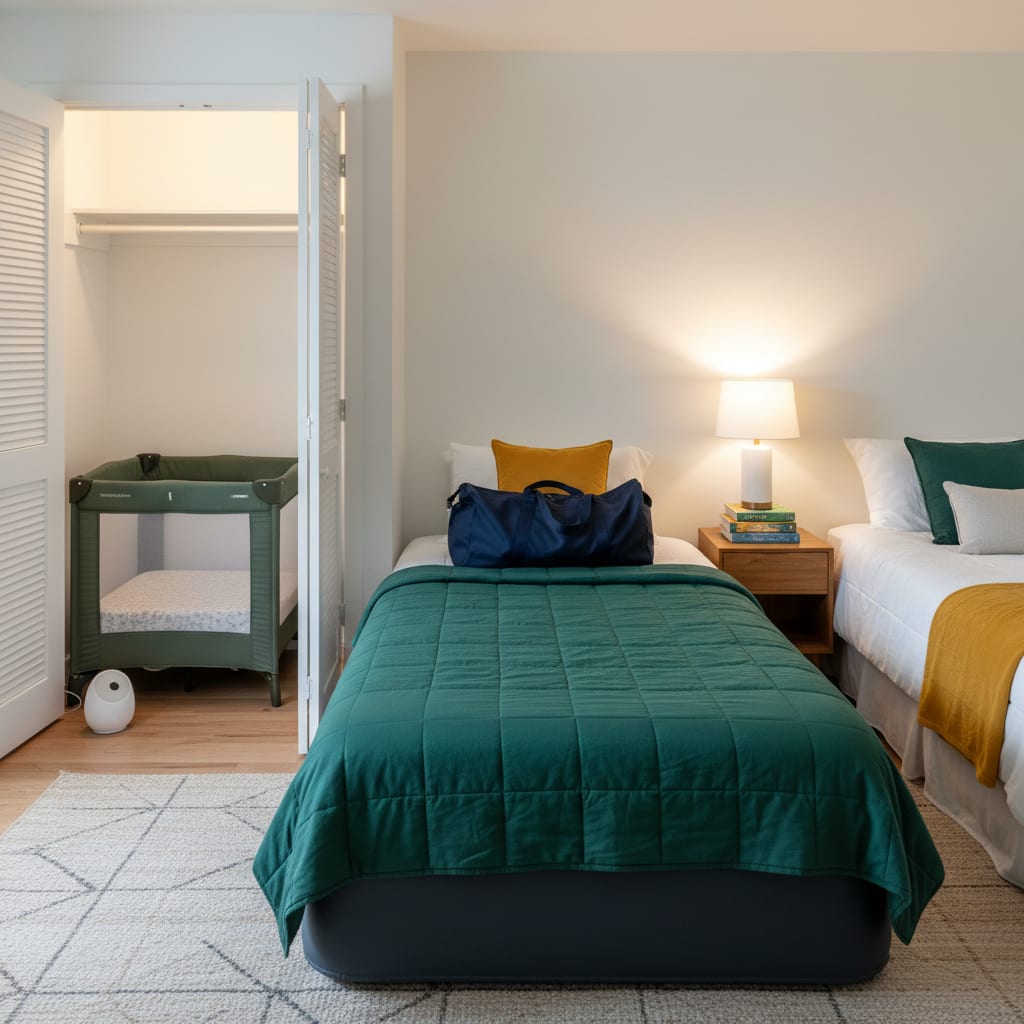
The way to sleep six-plus people in a rental that sleeps “eight” (four of those on sofa beds) is to assign rooms before you arrive, and assign them by wake style, not by age: early wakers together, night owls together, the baby in the most sound-isolated spot even if that spot is a walk-in closet, and white noise covering every door gap. Do that, plus a boring first night, and a four-kid rental week actually works. Wing it, and you’ll spend the vacation re-solving bedtime every single night at 9 p.m. in a hallway.
We’ve run this playbook through beach houses, a cabin with one hallway and zero doors that latched, and one memorable rental where the “third bedroom” was a loft with a ladder. Here’s the system.
Room assignments: sort by wake style
At home, kids sleep where their stuff lives. In a rental you get to re-draft the teams, and the draft criteria is: who can be unconscious near whom. My sorting rules, in priority order:
- The baby or toddler gets the isolation slot — the room farthest from the living area, because the adults will be awake and audible for hours after baby bedtime. Sound isolation beats room quality; the crib kid doesn’t care about the view.
- Early wakers room together. My 6 a.m. twins share, so their sunrise negotiations wake each other and nobody else.
- The night owl (our eleven-year-old) gets the sofa bed or loft — the “worst” bed is fine for the kid who falls asleep last, and it usually comes with the most distance from the 6 a.m. crew.
- Adults take the room that shares a wall with the youngest, not the primary suite at the far end. First-night wake-ups are a when, not an if, and a twelve-second response beats a hallway hike.
Kids who share at home can absolutely share on the road — the ground rules from our room-sharing playbook travel intact: staggered bedtimes for different-aged roommates, and lights-out means quiet even if nobody’s asleep.
The pack-n-play site survey
First fifteen minutes in any rental, while the crew unloads the car, I walk the unit scouting crib real estate. The qualities that matter: dark, cool, away from the living area, and not sharing airspace with a sibling who talks in their sleep. In order of preference:
- A walk-in closet. Genuinely the best baby bedroom most rentals offer — dark, quiet, snug. Door stays cracked, monitor goes in. Zero shame; this is a pro move.
- A big bathroom attached to an adult room works the same way for one or two nights.
- The corner of the adults’ room — fine, but plan on everyone tiptoeing to bed in the dark, so it’s my last resort, not my first.
Bring your own fitted sheet from home — the smell of home bedding is legitimate sleep equipment for a baby in a strange dark box. And run the setup before dinner the first night; assembling a pack-n-play at 7:40 p.m. in front of its overtired occupant is a rookie sequence.
White noise: the load-bearing appliance
A rental’s real enemy is novelty noise — unfamiliar pipes, a road, siblings through thin walls, adults doing dishes at 9:30. White noise doesn’t just soothe; it masks, and masking is what keeps one kid’s wake-up from cascading through four. The logistics:
- One machine per sleep space, and count the sofa bed as a sleep space. We travel with two machines (a compact Yogasleep Hushh packs easily) plus phone apps as overflow — an old phone on airplane mode running a free white-noise app is a perfectly good third machine.
- Aim it at the door gap, not at the bed. You’re building a sound curtain over the leakiest point.
- Match home settings — same sound, similar volume. The point is “this is normal,” not “this is loud.”
The kid who’s never slept with white noise before shouldn’t meet it on vacation. Introduce it at home the week before, so the machine carries the association of ordinary sleep to the new place.
The first-night plan
First nights in a new place run bad — later, weirder, with more callbacks. Plan for it instead of being surprised by it: arrive early enough to do bedtime at the normal time, run the exact home routine in the exact home order (bath, books, songs — same books; they’re luggage-worthy), and keep night one’s evening deliberately boring. No pool at 7 p.m., no cousins’ dessert party. The vacation starts on day two; night one is an away game, and away games are won with defense.
Expect the 2 a.m. disorientation wake-up from somebody, answer it fast and boring, and don’t invent a new arrangement at 2 a.m. — the fix for a rough night one is running the same plan on night two, when familiarity starts working for you instead of against you.
One honest caveat: logistics can only package the sleep your kids already have. A baby who fights bedtime at home will fight it harder in a strange crib, and a rental week is a rough place to discover that. If bedtime is already a nightly battle, that’s a home problem to solve before it travels — we used the sleep program at Betteroo to get our toddler’s bedtime settled, and their plans are built around your kid’s age and temperament rather than one method for everybody — with the honest caveat that no program survives without the boring consistency part, at home or on the road. The travel payoff of solid home sleep is real, though: a kid with a settled routine treats the routine itself as the bed. Take the routine anywhere, the sleep follows.
If bedtime’s the wobbliest part of your operation, their three-minute sleep quiz is a reasonable place to start — it’s the pre-trip fix, not the packing-list one.
FAQ: rental sleep for a big crew
Where should the baby sleep in a vacation rental?
The most sound-isolated spot you can find — and a walk-in closet with the door cracked genuinely beats most bedrooms: dark, quiet, and nobody tiptoes past. Run the pack-n-play (a Graco Pack ‘n Play On the Go, say) with a monitor, your own fitted sheet from home, and white noise at the door gap.
Should kids who don’t share a room at home share on vacation?
Yes, if you sort by wake style — early risers together, the night owl separate. A week of sharing with a compatible sibling goes fine; a week sharing with an incompatible one is why you draft the rooms before you arrive. We ran the same logic when twins joined the lineup: matched sleepers in one room beats matched ages every time.
How many white noise machines do we actually need to pack?
One per sleep space is the ideal; two machines plus a spare phone running a white-noise app covers most rentals. Prioritize the baby’s space and whichever room shares a wall with the living area — those are the two doors doing the most acoustic work.
What if the first night is a disaster?
Assume it will be mediocre and grade on a curve — new-place sleep is genuinely worse for a night or two, for adults too. Hold the routine, answer wake-ups fast and boring, and change nothing on night two. If bedtime is a battle at home and on the road, the fix is a real routine overhaul before the next trip — the same second-baby-era rule applies: sleep systems get built at home and then travel, never the reverse.