The Hand-Me-Down System: Storing Kids' Clothes Right
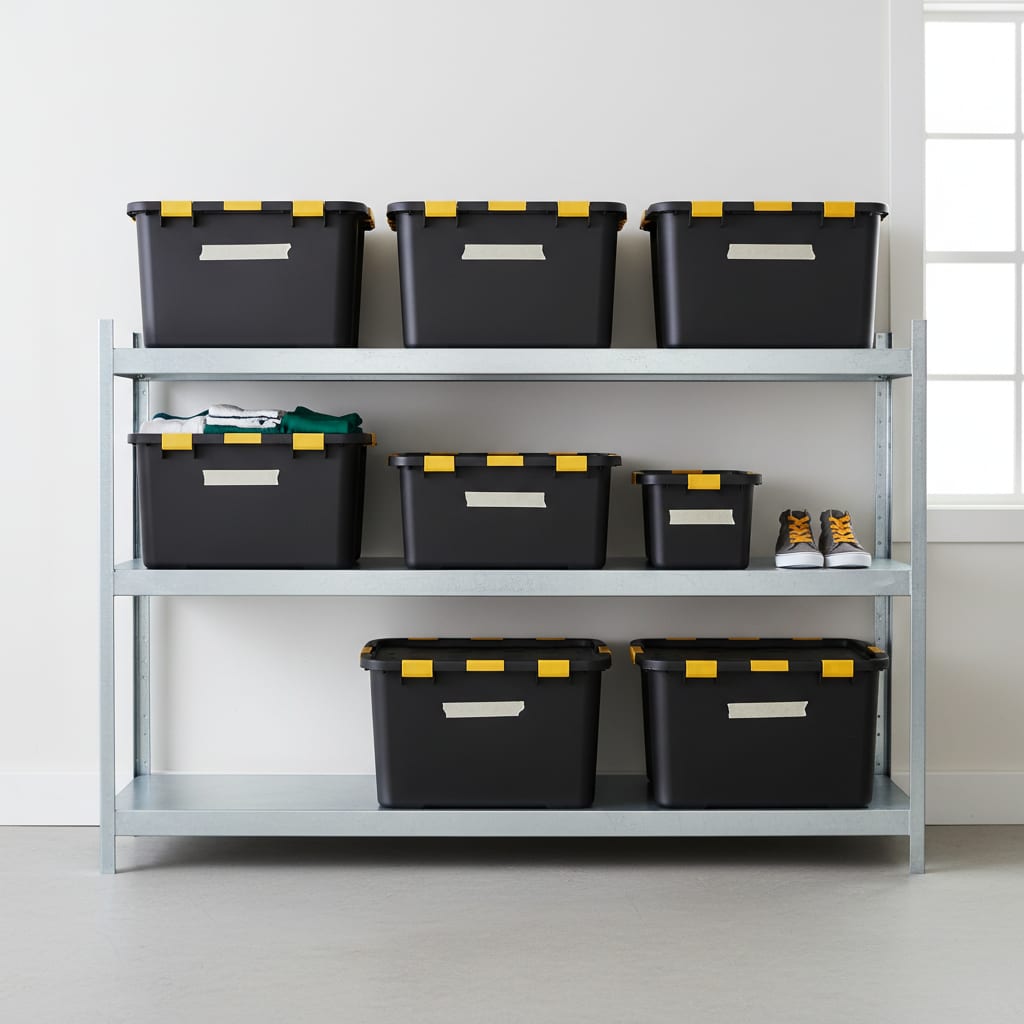
A hand-me-down system that works comes down to four rules: keep only what’s genuinely re-wearable, store it by size, never by child, in sealed labeled bins on a size-ordered shelf, and pull the next size up once a year instead of digging whenever something stops fitting. Do that and hand-me-downs become the cheapest clothing budget in the country. Skip it and you own eleven unlabeled bags in a garage, buy the size you already have twice, and discover the good winter coat in April. I’ve run five kids through this — including a twin pair who outgrow things in stereo — and the whole thing lives or dies on the labeling.
Ruthless triage at the outgrow point
The system starts the moment something stops fitting, not at the end of a season. A garment that leaves a kid’s body goes into exactly one of three places, decided on the spot:
- Keep — good condition, will fit somebody in this house within about two years, and is a category worth storing (outerwear, shoes in good shape, jeans, sweatshirts, snow gear, dressy items, anything expensive).
- Pass on — fine, but no one here will wear it: wrong season pattern, wrong gender preference, or the gap to the next kid is too long. Out of the house this week, to a friend, a buy-nothing group or donation.
- Bin it — stained, pilled, thin at the knee, or stretched out. Storing a worn-out garment costs you the same shelf space as a good one and gives you nothing.
That third category is where most families lose. The instinct at headcount is to keep everything because you might need it, and the result is bins full of things nobody will ever choose to wear. My working test is honest and quick: would I put this on the next kid for school picture day? No means it’s not storage, it’s postponed garbage.
A related rule that took me too long to learn: keep less of the cheap stuff and all of the expensive stuff. Nobody has ever regretted storing a snowsuit. Everybody regrets storing eleven graphic tees.
Bin by size, never by kid
This is the single decision that separates a functioning hand-me-down system from a garage of sadness. Bins are labeled with a size range and a season — “4T–5T winter,” “boys 8 summer,” “shoes 10–13” — and nothing else. Never a child’s name.
The reason is obvious once you see it: clothes flow between kids, so a bin labeled with a name is wrong the moment it’s stored. Sizes never change. A 5T bin is a 5T bin in ten years, for whichever kid arrives at 5T, including one you don’t have yet.
Practical specs from running this at five-kid volume:
- Opaque, latching, stackable totes — the industrial kind. A four-pack of 27-gallon latching totes covers about two sizes each for a mixed-season stash, and the latch is what keeps a garage bin from becoming a mouse bin. Cardboard boxes and trash bags both fail within a year.
- Label two faces — the end you’ll see on the shelf and the top, because bins get restacked by people who are not you.
- Big writing, replaceable label. Painter’s tape and a marker beats a permanent label, because a bin’s contents change identity every couple of years.
- One shoe bin per size band. Shoes are worth storing only if they’re barely worn — kids destroy footwear from the inside, and a molded-out sole is not a hand-me-down.
- Don’t overfill. A bin so heavy you dread pulling it is a bin you’ll stop pulling.
Store them in size order, smallest to largest, on shelves rather than in a stack. A stack means unstacking three bins to reach the one you want, which is precisely the friction that kills household systems.
Run the swap once a year
Sizing changes are not an emergency, so stop treating them like one. Once a year — late July or early August is the natural slot, right before school shopping — you do one swap for the whole crew:
- Try on the current season, kid by kid. Anything that no longer fits goes through the triage above, on the spot.
- Pull the next size bin for each kid, wash what’s in it, and put it in drawers.
- Note the gaps. Now, with the bins open, you know that the eight-year-old needs jeans and nobody needs coats. That list is what you actually shop from.
- Re-label and re-shelve anything that changed hands.
Half a day, once a year, and the payoff is that you stop buying duplicates — which is the real cost of a disorganized hand-me-down stash. Every family I know that has bought a winter coat in a size already sitting in the garage has bought it in October, in a hurry, at full price. The annual swap is what converts hand-me-downs from clutter into a genuine line-item saving, and it’s the same instinct as buying ahead on the categories in our bulk-buying breakdown: pay attention once, save all year.
Buy forward while you’re there. End-of-season clearance on next year’s size is the cheapest clothing money in the calendar — but only buy forward for sizes you’ve confirmed the bins don’t already cover, and only one size ahead. Two sizes ahead is a bet on a growth rate you can’t predict.
Making it survive a big crew
Give every kid a “no” allowance. Hand-me-downs work far better when kids get real veto power over a few items. A ten-year-old who is required to wear every single thing their sibling wore starts hating the whole system; one who can reject two or three items a season stops fighting the other thirty. Cheap concession, huge compliance.
Buy neutral for the middle of the line. Anything you buy new for a middle kid is a garment three more kids will wear, so durability and neutral colors are worth paying up for — and it’s why bulk multipacks of basics make sense here in a way they don’t for one-child households.
Give the outgrow pile a landing spot. One labeled bin or hamper in the laundry area for “too small,” emptied at the swap. Without a landing spot, outgrown clothes re-enter the wash, and washing clothes nobody in the house can wear is pure loss on a one-load-a-day laundry line.
Store where the humidity isn’t. Garages and basements are fine for latching totes if they’re dry; damp storage will cost you a whole bin of good clothes at once. Under-bed boxes work in a pinch, especially for kids sharing a room where closet space is already the constraint.
Sunset the whole stash when you’re done. When your youngest passes a size for the last time, that bin leaves the house. Keeping a full wardrobe archive “just in case” is how families end up storing clothes for children who are now adults.
FAQ: hand-me-down clothes storage
What size bins are best for storing kids’ clothes?
Latching totes in the 20–30 gallon range hit the sweet spot: big enough to hold a size band, light enough to lift alone. Opaque is fine if the labels are good; clear bins help but don’t replace labeling.
Should you store hand-me-downs by child or by size?
Always by size. Clothes move between kids, so a name on the bin is out of date the day you seal it, while a size band stays accurate permanently — including for children you don’t have yet.
How many sizes ahead should you keep?
Keep everything you’ll realistically use within about two years, and buy forward no more than one size on clearance. Beyond that you’re storing against a growth rate you can’t predict, and storage space is a real cost.
How do you stop hand-me-downs from feeling unfair?
Give each kid a small veto — two or three rejected items a season — plus something new that’s genuinely theirs at the annual swap. The resentment comes from having no say at all, not from wearing a sibling’s jeans.