Car Seats in the Third Row: What Actually Fits
Car seats can go in the third row of most three-row vehicles, but what fits there is decided by three things and none of them are the seat’s marketing copy: how many usable belt positions the third row actually has, whether those positions have a top-tether anchor, and how much bench width and legroom sits behind an already-occupied second row. Start with the vehicle owner’s manual, not the car seat. It lists which seating positions allow child restraints, where the tether anchors are, and whether lower anchors exist back there at all — and that document overrules every fit chart on the internet, including ours.
Read the vehicle manual first, then the seat manual
Both manuals are load-bearing, in this order.
The vehicle manual tells you: which seating positions are approved for child restraints, where the top-tether anchors are located and what they look like (they’re often on the seatback, the cargo floor or the ceiling in a third row), whether the third row has lower anchors, and any weight limits on lower anchors for that vehicle. Third rows very often have fewer lower-anchor positions than the second row, sometimes none — which does not mean a car seat can’t go there. It means it installs with the seat belt instead.
The car seat manual tells you: whether that seat can be installed with a lap-and-shoulder belt, how to lock the belt, whether the seat can be used in a position without a top tether when forward-facing, and how much space it needs behind it or in front of it.
A seat-belt install done correctly is every bit as safe as a lower-anchor install. In a third row, belt installs are the norm rather than the exception, so if you’ve only ever used lower anchors, this is the skill to learn before you go shopping. A local certified child passenger safety technician will check your install for free in most areas — worth doing once for a third-row setup, because the geometry back there is genuinely fiddlier.
Measure the bench, not the brochure
Third rows are narrower than second rows in almost every vehicle, and the useful measurement is not the “seats eight” claim on the window sticker.
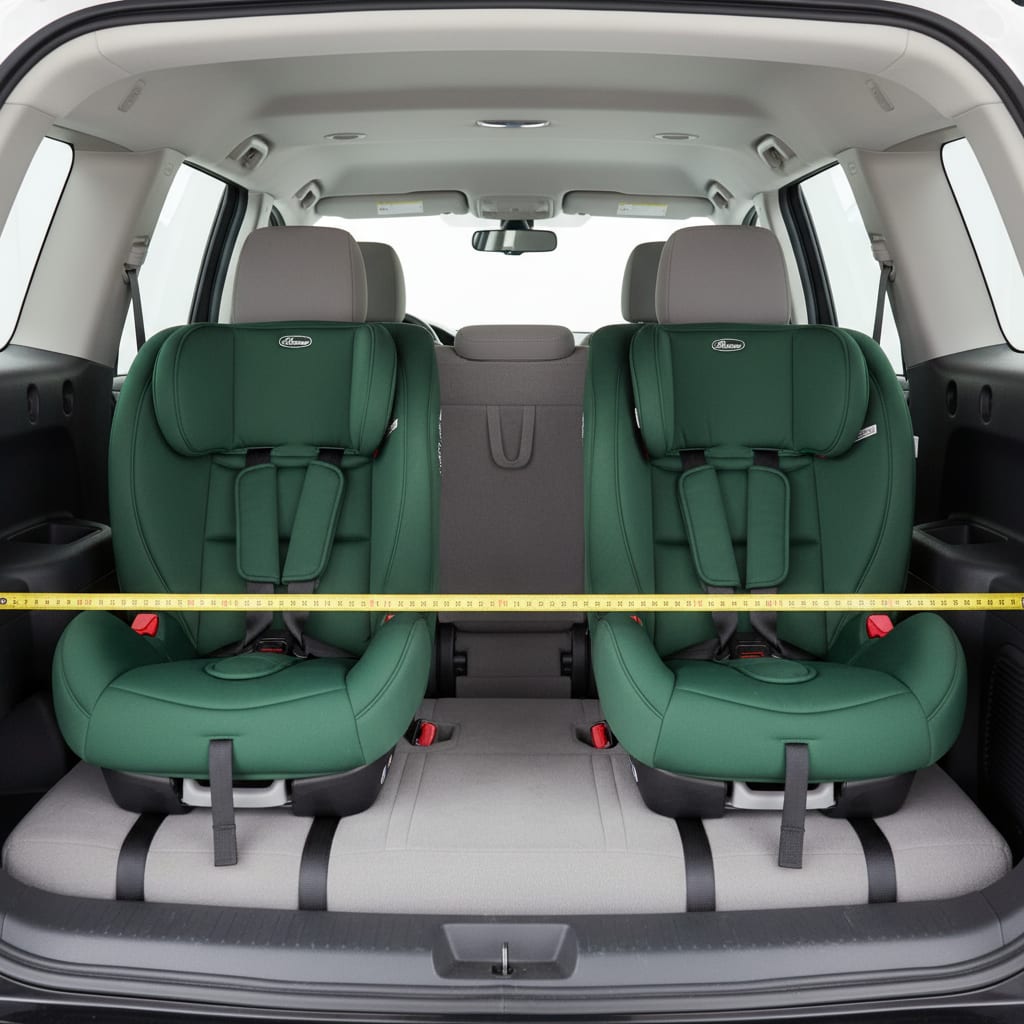
Measure, with a tape, in the actual car:
- Usable bench width between the interior panels at the height where car seats sit — not at floor level, and not at the widest point of the trim.
- Each belt position’s spacing. Buckle stalks that sit close together will fight a wide car seat base even when the bench is wide enough on paper.
- Legroom in front of the third row, with the second row where it will actually live. A rear-facing seat in the third row needs the second row moved forward, which then compresses whoever sits there.
- Headroom and the tether path. A tall convertible seat plus a sloping rear roofline is a real constraint in SUVs.
Then compare against the car seats’ external widths, which manufacturers publish. Add up the seats going in the row and leave a finger’s width between each — a row that measures exactly to the millimetre won’t buckle. This is the same width arithmetic as our 3-across car seat guide, just applied to a narrower, more awkward bench.
The access problem nobody mentions
Here’s the tradeoff that decides most real family setups, and it barely appears in car-seat coverage: a car seat installed in the second row usually blocks the path to the third row.
In most three-row vehicles, third-row access comes through one second-row seat that slides and tilts forward. Install a car seat on that position and it stops sliding — so whoever rides in the third row has to climb over, or use the other side, or you give up a second-row seat entirely to keep the aisle open.
Three configurations big families actually run:
- Captain’s chairs with an open aisle. Two second-row captain’s chairs with a gap between them means third-row riders walk through without touching a car seat. This is the single biggest practical advantage of captain’s chairs, and it’s why the seating layout matters more than the badge — the argument we run through in full in the minivan versus SUV comparison.
- Bench second row, car seats outboard, access via the pass-through side. Works if only one second-row position holds a car seat and it’s on the non-access side.
- Car seats in the third row, big kids in the second. Counterintuitive but often the right answer once your youngest can climb in themselves or once you’re loading them from the tailgate side. It also keeps the second row usable for adults.
There’s no universally correct layout. There’s the one that matches which of your kids can buckle themselves and which door you load from.
What to look for in a seat destined for the third row
Nothing here is a spec claim about a specific model’s dimensions — check the manufacturer’s published width for the exact version you’re buying, because widths change between model years and trim variants.
Narrow, straight-sided seats win in third rows for the same reason they win 3-across: the constraint is width at the base, and flared cup holders eat the space you need. The slim convertibles that make our narrowest car seats roundup are the same shortlist here — something like the Diono Radian 3R is built around that narrow footprint and is a common answer for tight rows, though you still have to check the fit in your own vehicle rather than trusting any list.
A low-profile shell matters more here than in the second row, because of the roofline and because a tall seat can block your rear visibility entirely.
Easy belt-path access. In a cramped third row you’ll be installing at an awkward angle. Seats with an open, clearly marked belt path are dramatically easier to get tight back there.
Boosters are the easy win. A high-back or backless booster needs a lap-and-shoulder belt and good belt geometry, not anchors — which makes a booster-aged kid the simplest passenger to put in a third row. Check that the third row has shoulder belts in the positions you plan to use; some vehicles have a lap-only belt in one position, which rules out boosters there.
FAQ: third-row car seat installation
Can you install a car seat in the third row?
In most three-row vehicles, yes — but only in the positions your vehicle manual approves, and often with the seat belt rather than lower anchors. Check the manual for approved positions and tether anchor locations before buying anything.
Do third rows have LATCH anchors?
Sometimes, and often fewer than the second row. Plenty of vehicles have lower anchors in only one third-row position, or none. A correct seat-belt installation is equally safe, so the absence of lower anchors isn’t a dealbreaker.
Is the third row safe for a car seat?
Third-row positions approved by the vehicle manufacturer are safe for correctly installed child restraints. Follow the vehicle manual for approved positions and the seat manual for installation, and get the install checked by a certified technician if you’re unsure.
Which kid should sit in the third row?
Practically, the one who can buckle independently — usually a booster-age or older kid, since reaching a young child in the third row while driving is impossible. That also keeps the second-row aisle free for everyone else to get past.