Back-to-School Shopping for 4 Kids Without Panic
Back-to-school shopping for four or more kids works when you shop the gaps, not the lists. Inventory what’s already in the house first, consolidate every kid’s supply list into one bulk order, buy shoes and backpacks properly and everything else cheaply, and delay half the clothing until October. Done in that order it’s one afternoon and one order. Done the usual way — a store trip per child, list in hand, in the last week of August — it’s four trips, several hundred dollars of duplicates, and a kid who still doesn’t have a glue stick on day one. I run five kids through this every year, and the whole thing turns on the step nobody does: counting what you already own.
Inventory before you buy anything
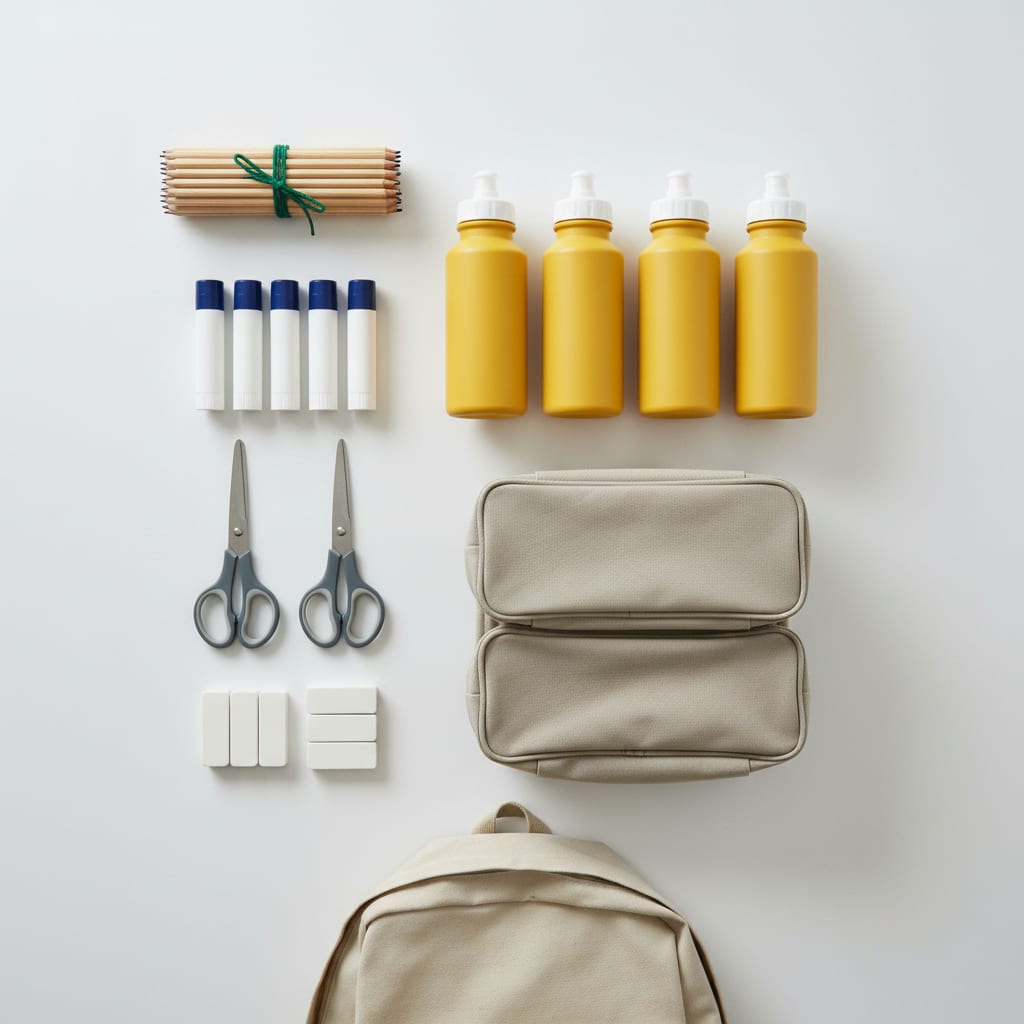
Pull out every bin, drawer and backpack in the house and lay the contents out by category: pencils, markers, folders, glue, scissors, notebooks, backpacks, lunch boxes, water bottles, gym shoes. It takes about 45 minutes with helpers and it is the highest-value hour of the whole season.
Two things happen. First, you discover you own eleven glue sticks and no scissors, which means the list you shop from is now half as long. Second, the kids see the supply stock, which noticeably reduces the number of things they insist they need.
Do the clothing side the same way, and do it as one event: the annual size swap out of the hand-me-down bins belongs in late July or early August precisely because it produces the shopping list. Pull the next size for each kid, try it on, and write down only what’s genuinely missing. Every family that skips this step buys a jacket that’s already in the garage.
One consolidated order, not four store trips
Once you know the gaps, combine every kid’s list into a single master list, sorted by item rather than by child. Four kids needing two glue sticks each is one purchase of eight, not four separate purchases.
- Buy shared consumables in bulk. Pencils, glue sticks, markers, loose leaf, index cards, tissues and hand sanitizer are the same object regardless of grade. Buy the big pack once and refill from the household stock in November, when everything has already been lost — which is the real reason a big family should over-buy consumables slightly and under-buy everything else. It’s the standard bulk rule: buy deep on things that don’t expire and do get used up.
- Keep a supply overflow bin. One labeled bin in a closet holds the surplus. When a kid loses a pencil case in October, it costs a walk down the hall instead of a store run.
- Buy specifics separately. Teacher-specific asks — a particular binder, a certain calculator, a specific folder color — are the only items worth shopping individually, and they’re usually few.
- Order online where you can. With this many kids, the cost of a store trip is measured in hours and impulse buys, not in shipping.
Spend where the item has to survive
The categories worth real money at big-family volume are the ones that get destroyed or handed down. Everything else is a commodity.
Backpacks. Buy one good one per kid and expect it to last several years and then pass down. A JanSport SuperBreak is the classic here for a reason — simple construction, no gimmicks, and a warranty that survives siblings. Character-branded backpacks are a one-year purchase twice over: they wear out and the kid outgrows the character.
Shoes. Fit properly, in person, and don’t buy ahead. Shoes are the one category where hand-me-downs mostly fail, because the sole molds to the first kid’s gait. Buy one good pair of sneakers per kid per school year and a cheap second pair for gym or mud.
Lunch boxes and water bottles. Buy identical models across all the kids — a Bentgo Kids box, for instance. It sounds joyless; it’s actually the single best labor-saver in the kitchen, because identical containers stack, share lids and run through the lunch assembly line without a sorting step. Colors can differ. Shapes should not.
Coats. Buy quality once for the biggest kid and let it flow down. This is the highest-value single purchase in a big family’s clothing year.
Everything else — folders, pencil cases, notebooks, most clothing — is a commodity, and the store brand is genuinely fine.
Stagger the clothing, don’t front-load it
The most expensive back-to-school mistake is buying a full wardrobe per kid in August. Kids grow between August and November, tastes change within three weeks of school starting, and the clothes bought in a panic are the ones nobody wears.
Buy about a week’s worth of what each kid actually needs now, plus shoes, plus outerwear if the bins came up short. Then wait. The rest of the wardrobe gets bought in October, when you know what fits and what they’re actually wearing — and when the prices are better, since school clearance starts in September.
Same logic in reverse for next year: end-of-season clearance is where the cheap clothes are, one size up, in the categories you’ve confirmed the bins don’t cover.
If you’re doing this on a fixed number, decide the number before you shop, per kid rather than for the household — the same per-person framing that keeps a large family budget honest, because “back to school” is not one expense, it’s four or five parallel ones.
Label everything on the same night
The last step is the one that determines whether any of this survives to October. Set aside one evening after the shopping is done and label, in this order: every water bottle, every lunch box, every coat, every backpack, every pencil case, and the inside collar of gym clothes. A permanent marker is enough; iron-on or stick-on name labels are faster if you’re doing five kids.
Then load the launch pad. Backpacks go on hooks, shoes go under them, water bottles go in the fridge — the fixed staging that makes the 45-minute school morning possible. Doing this on shopping night rather than the night before school means the first morning is a rehearsal of a system that already exists, rather than an improvisation.
FAQ: back-to-school shopping with several kids
When should you start back-to-school shopping for a big family?
Late July for the inventory and size swap, early August for the consolidated supply order, and hold about half the clothing budget until October. Starting earlier mostly means buying things twice.
How do you save money on school supplies for multiple kids?
Shop the gaps rather than the lists, combine all the kids’ lists into one bulk buy for shared consumables, keep the surplus in a labeled overflow bin, and only shop item-by-item for the teacher-specific requests.
Is it worth buying expensive backpacks?
For the categories that hand down, yes. A well-built backpack outlasts two or three kids and works out cheaper per year than a themed one replaced annually. Shoes are the opposite case — buy those to fit, not to last.
How do you keep track of whose stuff is whose?
Buy identical models where you can and label everything on one night, right after shopping. Identical water bottles and lunch boxes save real time in the kitchen; labels save the arguments.