Packing 4 School Lunches in 10 Minutes (Assembly Line)
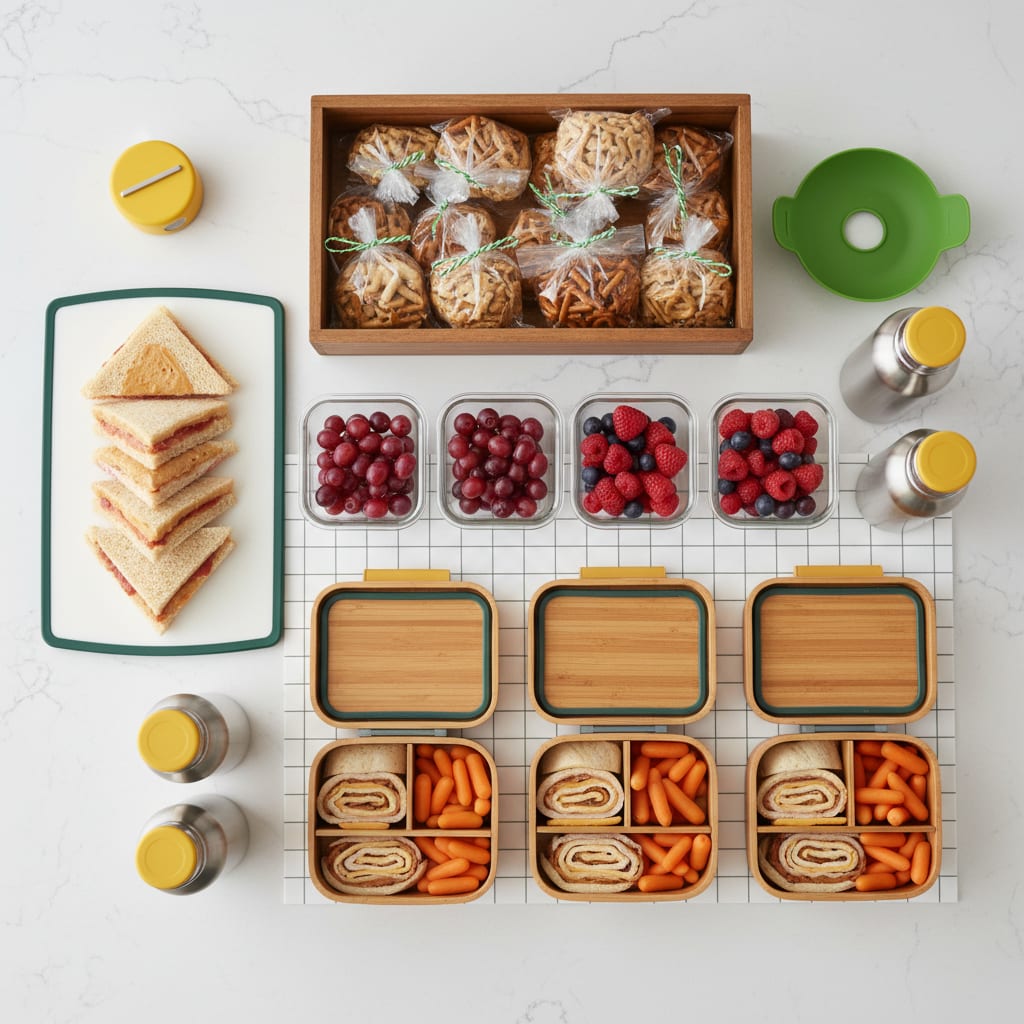
Packing school lunches for four kids in ten minutes is an assembly-line problem, not a creativity problem: line the boxes up open (identical Bentgo Kids bento boxes, say), fill them one component at a time across all four (all mains, then all fruits, then all crunch, then all extras), and stage every component the night before so the morning is pure assembly. That’s it — that’s the system. One person filling four boxes station-by-station beats four boxes built one at a time, every day of the week, for the same reason a line cook plates ten covers by moving down the line instead of finishing each plate solo. I plated food for a living before I packed lunches for a living; the physics didn’t change, just the clientele got pickier.
Why one-at-a-time lunch packing fails at four kids
Build each lunch start-to-finish and you pay the setup cost four times: open the bread, get out the knife, wash it, put it away, find the crackers, reseal the crackers, repeat until the bus is visibly leaving. Batch by component and you pay each setup cost once. The knife comes out once. The berry container opens once. Your hands make the same motion four times in a row, which is fast, instead of sixteen different motions in a loop, which is chaos.
The other failure mode is decision-making at 7:05am. The assembly line doesn’t ask you to decide anything in the morning — deciding happened the night before, or better, on Sunday when you built the weekly meal plan. Mornings are for hands, not brains.
The five-slot formula (one lunch, infinitely repeated)
Every box in this house gets the same five slots. The contents rotate; the structure never does:
- Main — sandwich, wrap, thermos leftovers (a Thermos Funtainer food jar), or the cracker-and-protein pick-plate
- Fruit — whatever was cheap this week, prepped Sunday
- Crunch — crackers, pretzels, popcorn; bought in bulk, portioned into a grab bin
- Extra — cheese stick, yogurt tube, boiled egg, the rotating fourth thing
- Water bottle — filled the night before, living in the fridge door
A fixed structure is what makes the line fast — nobody stands at the counter inventing a lunch. It also ends the fairness wars, because every kid can see every box got the same five slots. If one of your four is a picky eater, the formula flexes without breaking: swap contents within a slot, never delete the slot. (Same philosophy as our one-dinner picky-eater rule — the menu bends, the system doesn’t.)
Night-before staging: the real ten-minute secret
The morning line is only fast because the mise en place happened at 8pm. Sunday and nightly, in restaurant terms:
- Sunday prep (20 minutes): wash and portion fruit into grab-and-go containers, portion bulk crunch into a bin of snack bags, boil the week’s eggs. Bulk bags beat single-serve packs on price by a wide margin — the math lives in the what-to-buy-in-bulk guide.
- Nightly staging (5 minutes): boxes out and open on the counter, ice packs verified in the freezer, thermos preheating plan noted if tomorrow is a leftovers day, bottles filled and fridged.
- Morning line (10 minutes): mains built four across, then fruit dropped in four across, then crunch, then extras, lids on, boxes into backpacks. Done before the toaster finishes.
Put the crew on the line
Four lunches don’t have to be packed by one adult — this is a staffed kitchen if you staff it. My lineup: the 6-year-old twins run fruit and crunch (grab portioned containers, drop them in slots — zero knife work), the 9-year-old builds mains alongside me, the 11-year-old fills bottles, checks ice packs, and does final lid-and-backpack inspection like a very small quality-control manager. The toddler’s job is to be elsewhere.
Kids on the line is slower for the first week and faster forever after — and a kid who packed the lunch complains about the lunch at measurably lower volume. Full station assignments by age are in the kid kitchen jobs roster.
FAQ: assembly-line lunch packing
Should I pack lunches the night before instead?
Fully packing the night before works if your kids tolerate slightly-softened sandwiches; staging the night before and assembling in the morning keeps quality higher for nearly the same morning cost. Thermos items are morning-only either way. Pick one and make it the standing play — the system you repeat beats the system you optimize.
How do I handle four different sets of preferences?
Rotate contents within slots, never build four different lunches. Keep a short house list of approved options per slot — each kid flags vetoes once, at the Sunday plan, not at the counter. One line, minor substitutions, zero morning debates.
What about school allergy rules?
Treat the school’s allergy list as a hard filter on your slot options — cut the flagged items from the rotation entirely rather than tracking which kid’s classroom bans what. One compliant rotation is simpler than four conditional ones, and simpler is the whole point.
Is buying lunch cheaper than packing at this headcount?
Multiply the school lunch price by four kids and 180 school days and compare it to your bulk-fueled rotation — for most big families packing wins clearly, especially when the crunch and fruit slots come from warehouse-sized bags. Run your own numbers with the cheap-meals cost math as a baseline.