Sleep in a Big Family When One Child Needs More at Night

When one of your kids needs extra care overnight and the nights were already broken before that started, the thing to fix isn’t the bedtime routine. It’s how you ration adult night capacity. Decide in daylight who is on call and who is genuinely off, put the child who needs the most on the shortest route to whoever is awake, and shrink the number of people any one wake-up can reach. Your child’s clinicians own everything medical about their nights; this post is only the household side — shifts, routes, doors and sound.
Count your night capacity before you plan the night
Most bedtime advice quietly assumes an unlimited supply of awake adult. Where one child needs support at 1am and again at 4am and four other kids each wake occasionally, that supply is the binding constraint — and nobody ever counts it.
So count it once, on paper. In a normal week: how many nights does the highest-need child wake, and how often? How many wake-ups come from everyone else combined? And how many adult-nights do you have — two adults across seven nights is fourteen, minus whatever shift work or a solo stretch has already spoken for.
If the wake-ups exceed the adult-nights, no routine fixes that and trying harder won’t either. That’s a staffing problem, and the honest options are three: shift the load between adults, reduce the number of other people who can wake, or bring in help. Sequencing bedtime differently is the smallest lever on that list, which is why it feels useless when it’s the only one you pull. Write the count down — a number is harder to argue with than “we’re not sleeping.”
One adult is genuinely off duty, every night
With two adults, split the night into shifts and make the off-duty half real. Not “you sleep, I’ll get you if it’s bad.” Real: a closed door, earplugs, a different room if there is one, and a rule that the off-duty adult isn’t woken except for a named list agreed in daylight.
What destroys people isn’t the wake-ups. It’s both adults surfacing for every one, converting a four-wake night into eight adult wake-ups and buying nothing. Two half-rested adults outlast one wrecked adult and one guilty one.
Two ways to cut it, and either works:
- By clock. One adult owns until 2am, the other owns 2am to wake-up. The second shift gets the worse hours, so alternate it night to night.
- By child. One adult owns the highest-need child, the other owns the rest of the house — worth it when one of you is genuinely faster at the care itself. Swap at fixed intervals anyway, or the person who never does it stops knowing how.
Solo, the structure still applies; you just aren’t the second shift. Defend one block hardest — usually the first, the longest continuous run available. And be specific with anyone who offers help: not “come round sometime,” but “Thursday, 7 to 10pm, so I can sleep before the night starts.”
Put the shortest route between the on-call adult and the child who needs them
Room assignments are usually decided by age, fairness or who got there first. Here they’re decided by traffic. Whoever needs the most support at night goes closest to the on-call adult, on the shortest, straightest, least-doored route. Crossing the house eight times a night, the gap between eight steps and thirty is the gap between going back to sleep and not — and every door you pass can wake somebody who wasn’t part of this.
The rest follows: nobody sleeps in the walking lane, the lightest sleepers go furthest from the route, and the route gets rugged, dimly lit and cleared of anything you can stand on in the dark. Same corridor thinking as fixing an older sibling who wakes the baby, run in reverse — there the traffic was accidental, here it’s scheduled.
Shrink what a single wake-up can reach
The multiplier in a big family isn’t the wake-up. It’s the cascade: one child needs you at 1am, a sibling hears it, the toddler hears the sibling, and by 1:40am three people are awake and nobody’s been helped.
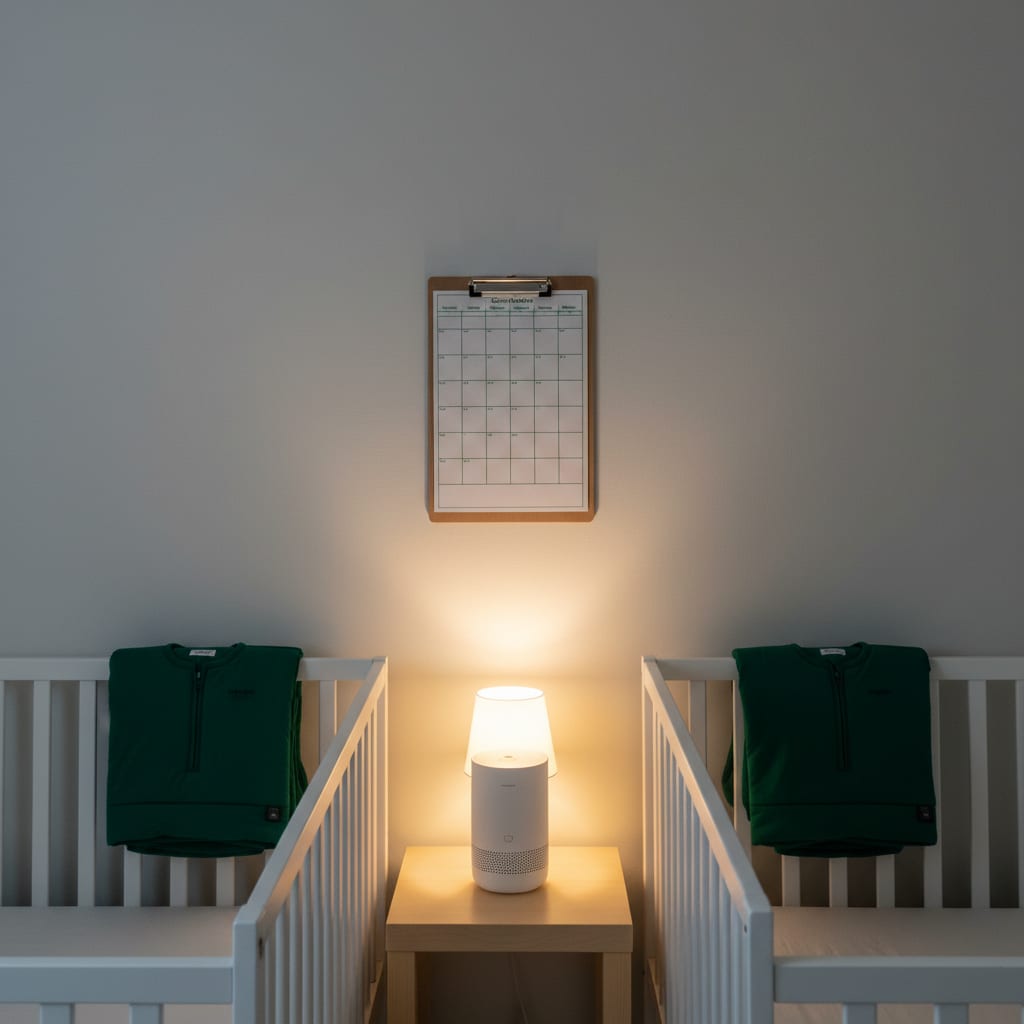
Cut the chain in three places. Doors closed, all of them, including the ones you’d rather leave open — that alone does more than everything else here. A constant sound floor in every sleeping room, all night, so the change in level from a door or a voice doesn’t register; a mechanical machine like the Yogasleep Dohm Classic is the workhorse because it can’t loop. And one dim light on the route, permanently on, so nobody hits an overhead switch at 3am.
If there’s also a baby whose own nights are fragmenting, treat that as a separate problem with its own fix — Betteroo’s guide to a baby who’s up every hour is a better use of an hour than another rearranged rota.
Stop running two bedtimes at the same time
The evening version of the cascade is settling two children who need different things in the same twenty minutes. It turns a hard night into a lost one before it starts.
Sequence instead. The child whose settling is longest, least flexible or most dependent on one adult goes into the quietest window — normally first, door shut behind them. Every other bedtime is the elastic part, and elastic is what you work with; my post on bedtime when one kid needs quiet and one needs company has the mechanics of running two incompatible wind-downs back to back.
Watch for the sibling whose bedtime looks fine and collapses forty minutes later, right as you’ve started the other one. That’s its own pattern rather than defiance, and Betteroo’s write-up of the false-start bedtime explains what shifts it.
Give the siblings back daylight, not a night job
Siblings here notice everything and ask for very little, which is exactly the problem.
Two rules. First, they are not night staff. A ten-year-old fetching things at 2am is a ten-year-old going to school tired. Give them one instruction — stay in bed, we’ve got it — and nothing else.
Second, pay them back in daylight, in named amounts. Not “we’ll do something soon,” which never survives a bad week. Twenty minutes, a specific person, a specific day, protected the way the rota is. Small and reliable beats large and cancelled — the same currency behind the runway idea in my post on bedtime for a highly sensitive child. And tell them the plan, at their level: kids fill silence with worse explanations than the truth.
Set the review date, and the line for asking for help
Temporary broken nights and indefinite ones need different plans. A week of illness gets contained and then undone — that’s my post on bedtime when one kid is sick. This isn’t that, so build it to run for months and put a date on the calendar to revisit it; kids change, and a rota nobody reviews ossifies.
Anything about your child’s health or what their nights should look like goes to their own clinicians. And if the count at the top says the wake-ups exceed the adults, say so out loud to someone. Running short-staffed indefinitely is a fact about the staffing, not a verdict on you.

FAQ: broken nights with a full house
How do you cope when one child wakes every night for years?
Treat it as staffing, not routine. Count the wake-ups against the adult-nights you actually have, split the night into shifts so one adult is genuinely off duty, and cut what a single wake-up can reach with closed doors and an all-night sound floor.
Should siblings help at night?
No. Give them one instruction — stay in bed — and pay them back in daylight, in small named amounts on a specific day. A tired sibling costs more the next morning than their help saves you at 2am.
How do you stop one child’s night waking from waking the whole house?
Close every door, run a constant sound floor in each sleeping room so changes in noise don’t register, keep one dim light on all night, and route night traffic past the fewest sleeping people possible.
Who should we ask about our child’s sleep itself?
Their own clinicians and care team. Anything about health, or what a specific child’s nights should look like, belongs with people who know that child — the plan above sits alongside their advice, never in place of it.