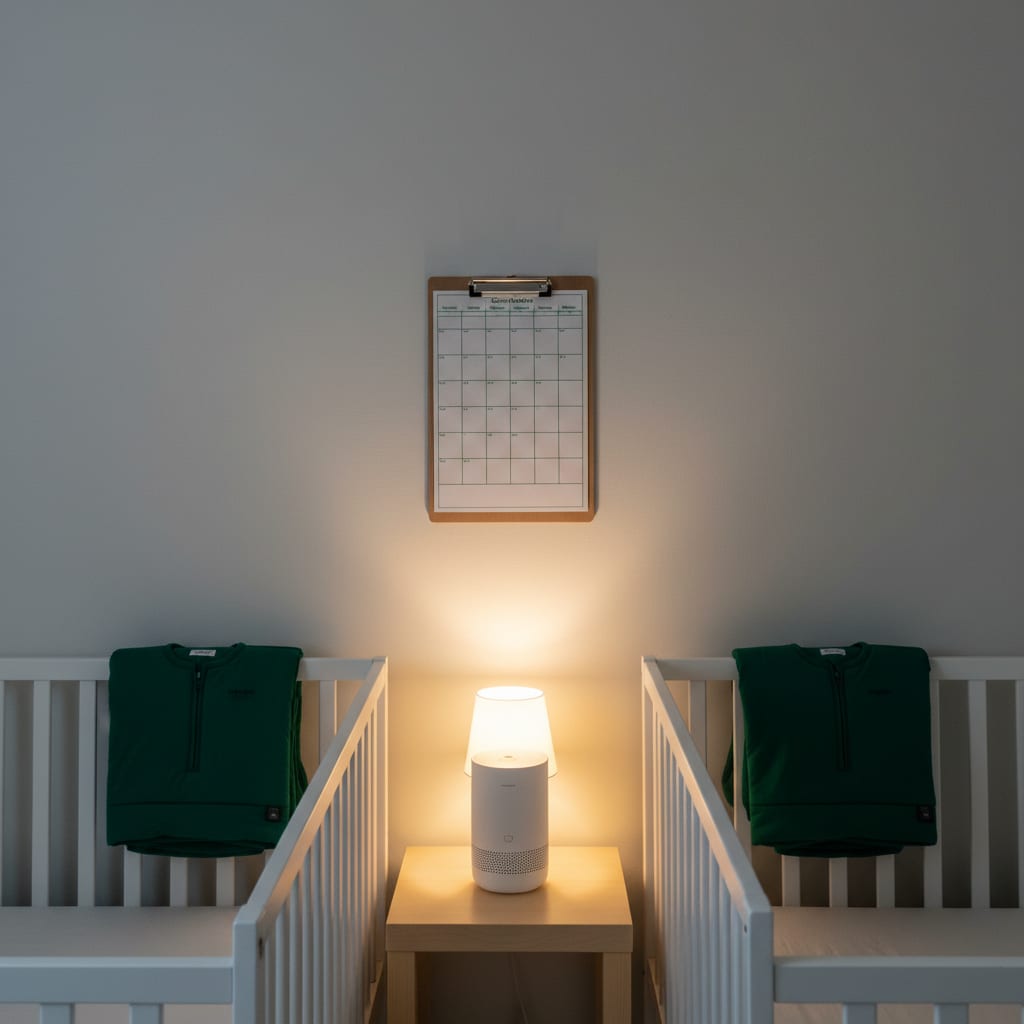
Preparing Your Toddler for the New Baby: 4-Week Plan

Preparing a toddler for a new baby is almost entirely a sequencing problem: every change the baby causes — the room swap, the crib eviction, the new daycare days — should happen weeks before the baby arrives, so the toddler never connects the loss to the newborn. Then you script three things: who has the toddler during the birth, how the first meeting goes, and what their job is in the first two weeks home. The talking-about-feelings part matters less than people think; the calendar part matters more. Here’s the four-week run-up, tested on four arrivals.
The one rule underneath everything: decouple the changes
A toddler doesn’t experience “a new sibling.” They experience specific losses — my crib, my room, my mom’s lap, my Tuesday — and if those land in the same fortnight as a newborn, the newborn gets the blame. That grudge is hard to unwind and completely avoidable.
So: any transition you were going to make anyway moves forward. Crib to toddler bed, room reshuffle, dropping a bottle, starting preschool, a new childcare day — all at least six to eight weeks ahead, so it’s old news by the time the hospital bag comes out. Which gear needs replacing and which can be reused is a separate audit, covered in second baby essentials.
If the crib is being handed down, a swing-down rail like the Regalo bed rail makes the first weeks in an open bed less eventful — it drops away for tuck-ins and stops the 2am roll-out that sends kids straight back to wanting the crib.
Four weeks out: the physical setup
Rooms first, because rooms take the longest to settle. Whoever is moving, moves now — and if bunks are going in, read the age rules in our bunk bed post first. Give the toddler a stake in the new space: they pick the bedding, choose which wall the bed goes on, carry their own books in. Ownership converts an eviction into a promotion.
Also this week: set up the newborn’s sleep space where the toddler can see it, and let them get bored of it. A bassinet standing in the corner for a month is furniture; a bassinet that appears with a baby in it is an invasion.
Three weeks out: rehearse the new normal
The week for boring rehearsals that pay off later.
- Practice the caregiver. Whoever has the toddler during the birth does a full solo run — a bedtime, a morning, a nap. Not a novelty visit; the real routine.
- Introduce baby-adjacent objects. Stroller out, car seat base in, bouncer assembled and left alone in the living room. Familiarity is cheap now and expensive later.
- Shift your one-on-one time to a fixed slot. Ten minutes, same time daily, phone down. Start now while it’s easy — the version that survives the newborn weeks is the one that already existed.
- Read the same two baby books on repeat. Two, not twelve — toddlers process through repetition, not variety.
Two weeks out: the language and the visitor plan
Talk about the baby in concrete, unglamorous terms. Not “you’ll have a best friend” — that promise comes due in three years and they will notice. Say what’s true: the baby will cry, sleep, eat and be boring for a long while, and they can help with specific things.
Give them real, named jobs now: fetch a diaper, pick the burp cloth, press the sound-machine button — jobs a two-year-old can complete and you will actually allow.
Brief the visitors too — grandparents, friends, whoever shows up — with one instruction: greet the toddler first, and don’t arrive holding a gift for the baby only. It sounds trivial; it sets the weather of every visit for a month.
One week out: the go-bag and the story
Pack the toddler a bag too — same time, same table, so their bag exists in the same story as yours. Then rehearse the sequence in three sentences they can repeat back: Mom goes to the hospital. You stay with Grandma and sleep in your bed. Then you come meet the baby. Say it identically every time; an unchanging script is the most reassuring thing you own. And do a bedtime handoff dry run: the caregiver runs the whole bedtime while you’re in the house but not in the room.
The first meeting: script it
Three rules, all of them about hands.
- The baby is in the bassinet, not in your arms, when the toddler walks in. Arms free for the toddler — the most repeated piece of sibling advice there is, because it works.
- The toddler leads. They look when they want, touch when they want, leave when they want. A toddler dragged over to admire a newborn remembers being dragged.
- Keep it short. Fifteen calm minutes beat an hour ending in a meltdown, and the meltdown is the version they’ll narrate later.
The gift-from-the-baby trick works better for three-year-olds than for younger toddlers, who don’t yet track who gives what. Better investment: a photo of the two of them from that first day, printed, at toddler height, on the wall within the week.
The first two weeks home: expect the wobble
Regression is the norm, not a red flag: sleep gets worse, potty training slips, vocabulary shrinks, clinginess spikes. It’s temporary and responds to attention rather than correction. The plays that carry the fortnight:
- Protect the fixed points. One parent does the toddler’s bedtime every night, unchanged, however chaotic the day. Newborn feeds are portable; a toddler’s bedtime is not.
- Narrate the baby’s boringness. “She’s crying because she’s tired. That’s all she does.” You’re managing a rivalry story before it forms.
- Let the toddler be loud. Don’t build a household where a toddler is shushed continuously for a newborn — newborns sleep through noise better than toddlers tolerate silence, and the resentment compounds. It helps to know what the fourth-trimester weeks are supposed to look like, so you’re not rearranging the house to fix something that’s just week two.
- Start nothing new. No potty training, weaning, room change or preschool start — the run-up existed to get those done already.
What changes when there’s already a crew
With baby four or five it’s easier in one way, harder in another. Easier: the older kids do enormous amounts of the work, and the toddler has models for how a sibling behaves. Harder: they’re competing against more people, and “you’re the big one now” means little when three bigger ones sit above them.
So give the toddler a rank that’s real — not “big sister” in the abstract but a specific job the older kids don’t do. Ours: official pacifier-finder, sound-machine operator, blanket-fetcher. Tiny roles, fiercely defended. When room assignments settle, run them through the pairing logic in the room-sharing playbook rather than defaulting to birth order.
FAQ: preparing a toddler for a new baby
When should you tell a toddler about a new baby?
Late — typically the last six to eight weeks. Toddlers have no sense of long timelines, so an early announcement is months of “is it today?” for no benefit. Move the physical changes early; deliver the news late.
How far in advance should you move a toddler out of the crib?
At least six to eight weeks before the due date, never in the same month as the birth. The goal: the toddler has forgotten the crib was ever theirs by the time somebody else sleeps in it.
Is it normal for a toddler to regress after a new baby arrives?
Yes — sleep disruption, potty accidents, babyish speech and extra clinginess are commonly seen and usually short-lived. Respond with attention and unchanged routines, not consequences. If it’s severe or lasts well beyond a few weeks, raise it with your pediatrician.
What if my toddler ignores the new baby completely?
That’s a fine outcome, often better than intense interest — indifference means they don’t feel threatened. Don’t force interactions; the relationship starts when the baby becomes responsive, months later.
How do you handle a toddler who is rough with the baby?
Supervise at all times, redirect physically rather than verbally, and give the toddler a competing job in the same moment. Roughness is usually attempted involvement with no motor control behind it — but never leave them unsupervised together.