Newborn Constipation and Broken Nights: When to Call

A newborn who grunts, strains, goes red and wakes screaming at 2am is frightening, and in most cases it is not constipation. Frequency isn’t the measure — plenty of newborns go days between stools — consistency is. Hard, dry, pellet-shaped stools, or a baby who seems genuinely unwell, mean you call your pediatrician. Straining hard and then producing something soft is a different thing. Either way this is a phone call, not a home experiment: in a baby this small, nothing goes in and nothing goes near the bottom without a doctor saying so.
The 2am version, with five people asleep upstairs
The baby has been down since nine. At two, they start grunting — not crying, grunting — then straining, legs drawn up, face purple, then a shriek that carries down a hallway with four other kids on it. You’re solving two problems at once: is my baby okay, and how do I stop this becoming a five-person night.
Big-family instinct is to grab the baby and get downstairs before anyone else wakes. Spend ten seconds looking first — it decides whether the rest of the night is management or a trip to the clinic.
Straining hard is not the same as constipated
Two situations, almost identical at 2am.
Straining with a soft result. The baby pushes, grunts, cries, goes red — then produces a soft or even runny stool. That’s a coordination problem, not a blockage: a newborn has to push and relax the right muscles at the same time, and many haven’t worked out the sequence yet. Some clinicians call it infant dyschezia; parents know it as grunting baby syndrome. It’s noisy, it wakes everybody, and it typically resolves with time rather than intervention.
Actual constipation. Hard, dry stools, sometimes small and pellet-like, difficult and painful to pass. This is about the stool itself, not the noise before it — and under a couple of months old it’s a reason to ring your pediatrician rather than wait and see.
The trap is frequency. Breastfed newborns can go several days without a stool and be completely fine — and a baby who goes six times a day can still be constipated if what arrives is hard. Look at what comes out and how the baby is otherwise, not at the calendar. If you’re unsure which you’re seeing, that uncertainty is itself the reason to call. Betteroo’s plain-English explainer on how newborn digestion actually works is a good daylight-hours read, alongside — not instead of — your pediatrician.
Red flags: stop reading and phone somebody
By the fifth baby I’d rather make an unnecessary call than sit on one. Contact your pediatrician, an out-of-hours line, or emergency care if you see:
- Blood in the stool, or on the wipe.
- Vomiting, especially forceful vomiting or anything green.
- A firm, swollen or distended belly, or a baby who cries when you touch it.
- Refusing to feed, or a clear drop in wet diapers.
- Fever in a newborn — in the early weeks any fever is a call, full stop.
- Unusual sleepiness or floppiness, or a baby difficult to rouse.
- No stool at all in the first days of life, or a marked change from an established pattern.
- Poor weight gain at a check.
- Hard, pellet-like stools under two months, whatever else is going on.
None of that is a diagnosis and this post isn’t one. It’s the list I keep by the phone so I don’t have to think clearly at 2am — the one thing nobody can do at 2am.
Do not run experiments on a newborn at 2am
This is the part where the internet will hurt you. In a newborn:
- No suppositories, no rectal thermometers used as stimulation, nothing inserted. Widely recommended online, genuinely risky, not something to attempt without a doctor telling you to.
- No juice, corn syrup, sugar water, laxatives, herbal remedies or gripe water as a fix. Newborns shouldn’t be getting water or juice at all, and every one of these is a pediatrician conversation rather than a 2am decision.
- Don’t switch or dilute formula on your own. A formula change can be the right answer and it’s a doctor’s call. Diluting is dangerous.
- Don’t start a supplement or probiotic because a forum said so.
- Be careful with leg-bicycling and tummy massage. Gentle handling is comforting; treating it as a technique to force a result is not, and pressing on a distended belly is exactly the wrong move.
With a baby this new, the only correct 2am intervention is comfort, and the only correct next step is a phone call in the morning — or tonight, if anything on the red-flag list is present.
Contain the night before it becomes a five-person night
The part nobody writes about, and the part that decides whether tomorrow is survivable.
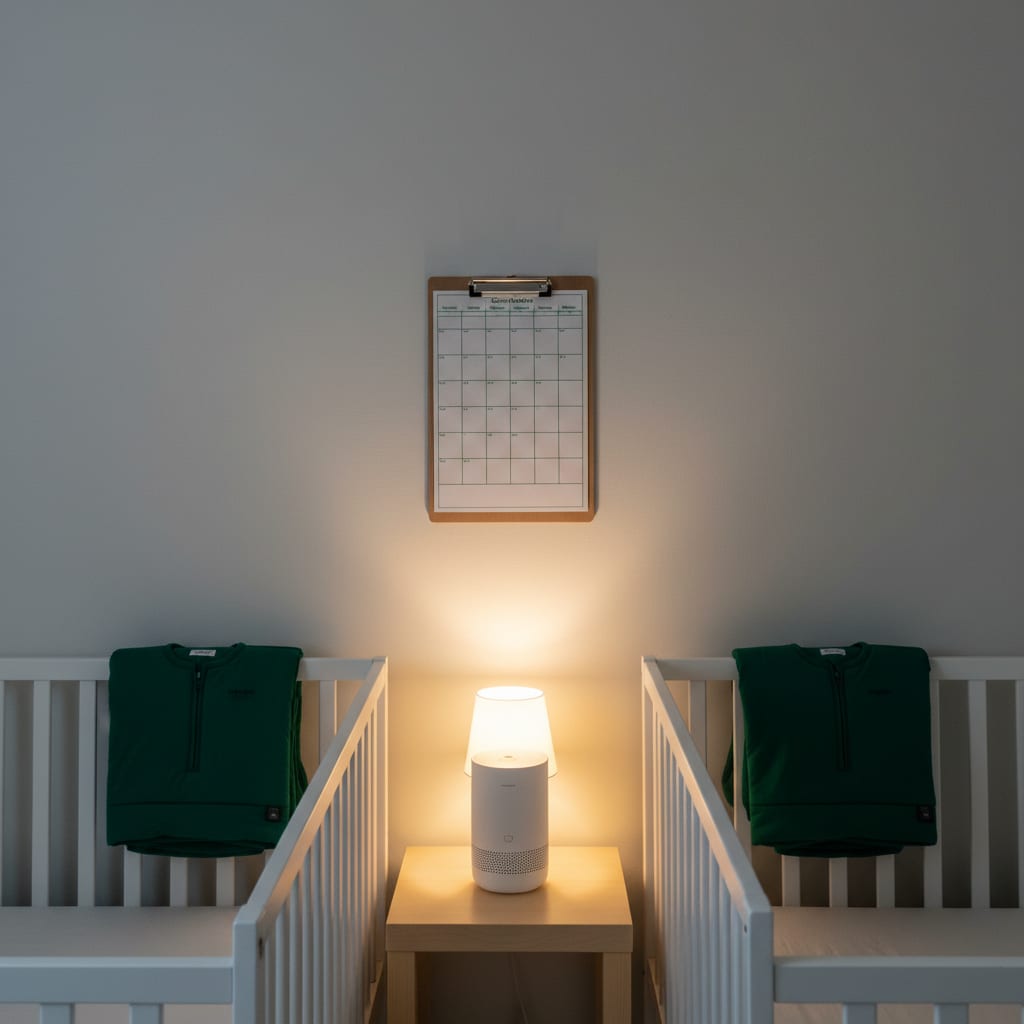
Have a designated night room, decided in advance. Somewhere downstairs with a chair, a lamp on its lowest setting and a blanket that lives there. Choosing where to go while holding a screaming baby in a hallway is how the hallway wakes up. Ours is the den — one of the few genuinely useful items on our second-baby list.
Move first, soothe second. Lift and go, then comfort behind a closed door two rooms away. Soothing in place next to four sleeping kids converts one wake-up into four.
The corridor does more damage than the crying. Door latches, hallway lights and hard floors wake siblings more reliably than a baby does — the hardware fixes in the hallway post take a weekend and hold every night after.
Split the night in shifts. Whoever is on takes the whole window; the other sleeps through with earplugs and no guilt. Both parents half-awake for four hours produces two wrecked adults and the same amount of baby care.
Protect the next day’s anchor nap. A rough night produces a shredded day, and a shredded day produces another rough night. Holding one protected daytime nap is what stops the spiral.
Then have your answers ready before you dial in the morning: when the last stool was and what it looked like, how feeding is going, wet diapers, any vomiting, whether the belly is soft, and how the baby seems between episodes. That last one carries the most weight and is the detail exhausted parents forget.
When the belly is fine and the schedule is the problem
Sometimes the digestion resolves, the pediatrician is satisfied, and the nights are still broken. You’re not looking at a gut problem then — you’re looking at an overtired baby on a schedule that stopped fitting, which produces the same 2am screaming and the same wrecked household.
That’s the piece I stopped eyeballing after the third kid. Getting wake windows and bedtime roughly right does more for a family’s nights than anything you can buy, and it’s ordinary arithmetic nobody can do at the end of a day with five children in it.

FAQ: newborn constipation and night waking
Is my newborn constipated if they haven’t pooped in days?
Not necessarily. Breastfed newborns especially can go several days between stools and be entirely well. Constipation is judged on hard, dry, difficult stools and on how the baby seems overall — not on the gap. Under two months and unsure, call your pediatrician.
Why does my newborn grunt and strain all night?
Often because they’re still learning to push and relax the right muscles at once — noisy, dramatic, and usually ending in a soft stool. That’s a coordination stage, not a blockage. Straining that produces hard pellets, or comes with vomiting, a swollen belly or blood, is a different picture and a reason to call.
Can constipation actually wake a baby up at night?
Discomfort can disrupt sleep, and so can the effort of straining. But bad nights that continue after the digestion settles are usually a schedule issue — an overtired baby, a bedtime that drifted late — rather than an ongoing gut problem.
What can I give a newborn for constipation?
Nothing without your pediatrician’s direction. No water, juice, corn syrup, laxatives, suppositories or herbal remedies, and no changing or diluting formula on your own. In a newborn these are medical decisions.
When should I take a constipated baby to the doctor?
Straight away for blood in the stool, vomiting, a firm or swollen belly, fever in a newborn, refusing feeds, fewer wet diapers, or unusual sleepiness. Otherwise call during office hours for hard pellet-like stools under two months, or any pattern worrying you.