The Large Family Laundry System (One Load a Day)
The large family laundry system that actually holds is one load a day, start to finish, every day — washed, dried, folded and put away before the next one starts. Not laundry day. Not four loads on Saturday. One load, one slot, no queue. With seven people in the house, laundry stopped being a chore the day I started treating it as a production line with a fixed throughput: about a load a day is roughly what a family of six or seven generates, so a load a day keeps the system at equilibrium instead of letting a backlog build that then eats a weekend.
Why the weekend-marathon model fails at headcount
With two people, batching laundry is efficient. With seven, batching is how you end up with eleven loads, a couch that’s been a clean-clothes landfill since Thursday, and a kid digging through the mountain for gym shorts. The math is unforgiving: volume scales with headcount, but your weekend does not.
The other failure mode is subtler. Marathon laundry always dies at the same station — folding and putting away. Washing and drying are machine work; folding is human work, and eleven loads of human work is a wall nobody walks through. So the clean clothes sit, get re-wrinkled, get re-washed, and the family effectively runs a second laundry operation on clothes that were already clean.
One load a day fixes both. A single load is folding you can finish standing up. Nothing accumulates. And the throughput is stable, which means the system has no bad days — only skipped ones, which cost exactly one extra load.
Sort at the source, not at the machine
The most expensive step in big-family laundry is sorting, and it’s expensive because it happens once, in a heap, on a floor, by an adult. Move it upstream and it costs nothing: every hamper in the house is already a category.
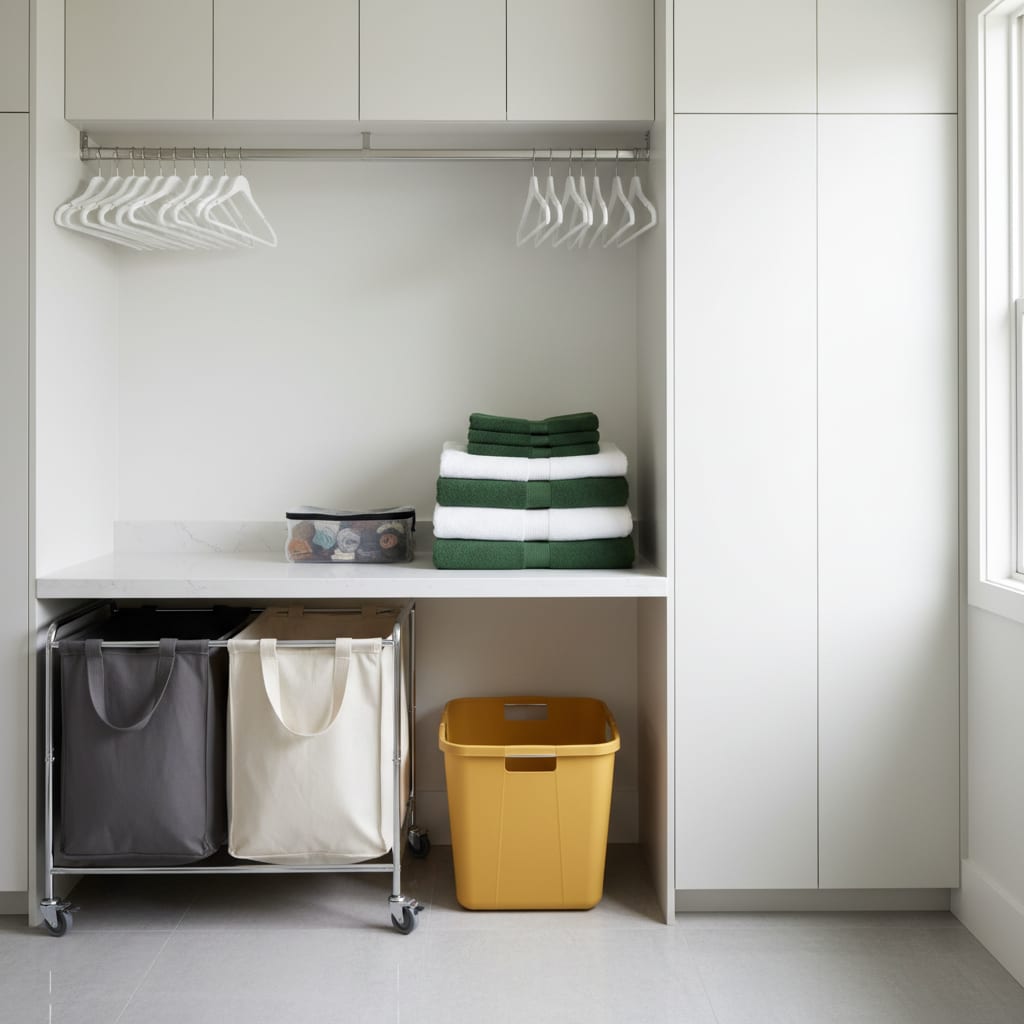
Ours runs on three streams, which is as many as a crew can keep straight: darks, lights, and towels-and-sheets. A three-bag rolling sorter in the laundry area is the hub — a triple laundry sorter on wheels means the “sort” step is just kids dropping items into the right bag on the way past, and the day’s load is whichever bag is full. Bedroom hampers feed it; nobody sorts anything twice.
Two refinements that earn their keep in a big house:
- One stain bucket, visible. Anything treated goes in the bucket, not the sorter, so a load never gets held hostage by one grass-stained knee.
- A “back tomorrow” shelf. Uniform, dance leotard, one specific jersey — items with a hard deadline get flagged into the next load rather than trusted to memory.
The one-load rhythm
The slot matters more than the hour. Pick a time that already exists in your day and attach laundry to it, because an unattached task is a task you’ll be reminded of by a laundry pile.
Mine runs: wash goes in during the school-morning launch sequence, transfers to the dryer at lunch, and folds during the after-dinner check — the same fixed hour I use for the chore roster check, because one enforcement moment is easier to protect than three. If you work outside the home, the equivalent is wash-at-night, dry-in-the-morning, fold-after-dinner. Any triangle works as long as it’s the same triangle daily.
Two non-negotiables inside the rhythm:
The dryer is not storage. Clean clothes that live in the dryer become clothes that get re-washed. Whoever’s on laundry duty empties it into a basket even if folding waits an hour.
Put-away happens the same day. A folded basket parked at the bottom of the stairs is a laundry system with a broken last mile, and the last mile is where every household system dies.
Hand the crew their piece
At headcount, the adult’s job is running the machines and holding the standard — not carrying every basket. Kids can own more of this than most families let them:
- Ages 4–5: carry their own basket to their room, sort clean socks, hand dirty clothes to the sorter.
- Ages 6–8: bring the day’s hamper down at a fixed hour, fold towels and their own basics, put away their drawer.
- Ages 9–11: run an entire load — start, transfer, fold, distribute — with a check at the end.
- Ages 12+: own their personal laundry end to end, on a named day, with the house rule that anything not in the hamper isn’t in the system.
That last rule is the whole discipline of a big-family laundry line, and it’s worth stating out loud to teenagers: if it’s on the floor, it’s not laundry. The line only processes what enters the line.
The sock problem, solved by removing it
Socks are not a laundry problem; they are a matching problem you have volunteered for. Two fixes, both boring, both permanent.
Standardize. One sock style per kid, bought in identical multipacks, replaced as a set. When every sock in a kid’s drawer matches every other sock, matching stops existing as a task. Different colors between kids if you like — that’s how ours are keyed.
Bag them. Each kid gets a zippered mesh bag that lives in their room; socks go in the bag, the bag goes in the wash, the bag comes out with every sock accounted for. A zippered mesh sock bag per kid costs less than the hour a week you’re currently spending on the orphan pile, and it also protects small items from vanishing into a sheet.
The same logic covers the rest of the outgrown-clothes pipeline: the moment something no longer fits, it leaves the laundry stream entirely and enters the hand-me-down bins. Laundry gets slower every time you wash a garment nobody in the house can wear.
When the system breaks
It will. A stomach bug, a week away, a broken machine — you come home to a backlog, and the temptation is to declare a laundry day and marathon it. Don’t. Run two loads a day until you’re level, then drop back to one. Two-a-day is survivable for a week; eleven-in-a-day is survivable never, and the marathon is what taught you to dread laundry in the first place.
And when you’re level, resist the urge to get ahead. There is no such thing as being ahead on laundry with seven people in the house. There’s only equilibrium — and equilibrium, unlike a spotless Saturday, is something a system can actually hold.
FAQ: big-family laundry
How many loads of laundry a day for a family of 6?
Roughly one load a day covers most families of six, more in seasons with sports kit, babies or bedwetting. Run one daily as the default and add a second temporarily when you’re catching up rather than switching to a weekly marathon.
Should each kid have their own laundry day?
For kids around twelve and up, yes — it teaches the whole cycle and removes them from your queue. Below that, one household line with kid hand-offs is more reliable, because a nine-year-old’s laundry day silently becomes your laundry day.
What’s the best way to sort laundry for a large family?
Sort at the hamper, not at the machine, into three streams — darks, lights, towels and sheets. Any more categories than a kid can hold in their head gets ignored, and re-sorting a heap on the floor is the most expensive step in the whole process.
How do you stop losing socks in a big family?
Buy one identical sock style per kid so matching becomes unnecessary, and wash each kid’s socks in their own zippered mesh bag. Between those two changes the orphan pile stops existing rather than getting better.