How Long Can a Baby Stay in a Car Seat?
The rule of thumb most pediatric advice and many car seat manuals land on is roughly two hours at a time for a young baby, with the seat coming out of use in between rather than the baby simply being carried indoors still strapped in. Alongside that sits the firmer, better-established point: a car seat is transport equipment, not a bed. The AAP is explicit that sitting devices — car seats, swings, bouncers, carriers — aren’t for routine sleep, and that a baby who falls asleep in one should be moved to a firm, flat surface on their back as soon as you can.
Check your own seat’s manual, too. Several manufacturers state a time limit of their own, and theirs governs their product.
Where the two-hour figure comes from
It is a rule of thumb, not a regulation, and it’s worth understanding the reasoning so you can apply it sensibly rather than watching a stopwatch.
A car seat holds a baby semi-upright with the head supported only by the shell and the harness. Young babies have limited head control, so over a long stretch in that position the head can slump forward and narrow the airway. That’s the concern behind the guidance, and it’s why the advice is aimed hardest at newborns and small infants — the babies with the least head and neck control — and eases as a baby gets stronger and can hold their own head up reliably.
Two practical corollaries follow, and both get missed:
The clock doesn’t reset when you park. If the carrier clicks into a stroller frame or a shopping trolley, the baby is still in the same semi-upright position. Two hours in the car plus an hour round a shop is three hours in the seat, not two separate short ones.
Preterm and small babies need a lower bar. Babies born early are often given a car seat tolerance screening before they leave hospital, precisely because the position is harder for them. If yours was premature or small, ask the hospital or your pediatrician what they advise for your baby specifically, rather than applying a general figure.
Never a bed, especially once you’re indoors
This is the part that actually matters most, and it’s the one big families break most often — because a sleeping baby in a carrier is the only quiet thing in the house and nobody wants to touch it.
The rule stands anyway. Bring the carrier in, and move the baby to a cot, crib or bassinet — flat, firm, on their back, nothing else in there. A carrier left on the floor is not a safe sleep space, and a carrier left on a sofa, a bed or a kitchen counter adds a fall risk to everything else. If the baby is asleep and you’re mid-school-run, the seat comes indoors with the baby in it and the baby comes out at the first opportunity, not at the first convenient one.
The same applies to the seat’s use as a general-purpose chair. Rear-facing-only carriers are designed for the car; a bouncer, a floor mat or somebody’s arms are better answers for the hours in between. Once you have four other kids providing entertainment, the floor mat wins on its own merits.
Planning stops when the drive is long
Here’s the version of this problem a big family actually has: it isn’t one baby and two hours, it’s a baby whose clock runs out at two hours, a toddler who needs the toilet at ninety minutes, and a nine-year-old who is fine for four hours and furious about stopping.
What works in this house:
- Set the schedule by the baby and bundle everything else into it. The youngest passenger’s limit is the constraint. Every other need gets attached to that stop rather than generating its own — toilets, snacks, legs, nappy, all at once.
- Budget the stop honestly. A real stop with a baby out of the seat, fed and changed, plus five other people through a service station, is not ten minutes. It’s closer to thirty. A four-hour drive with two full stops is a five-hour day, and planning it as four hours is what turns the last leg ugly.
- Take the baby fully out. The point of the stop is the position changing, not the vehicle stopping. Out of the seat, flat on a changing mat or held upright, for long enough to matter.
- Two adults means one sits in the back. Not to entertain — to see the baby’s head and airway. If you’re driving alone, that’s a hard argument for shorter legs and more of them.
- Drive the boring hours. Leaving at the crack of dawn or straight after bedtime shortens the awake time you’re managing. It doesn’t extend the two hours; it just makes them easier.
The full seating-chart and in-car logistics version of this is in our road trip with four-plus kids playbook — the stop schedule above is the piece that changes once there’s a baby in the lineup.
Watch the baby, not just the clock
The time limit is a backstop. The real check is what the baby looks like in the seat, which is why the person in the back seat matters more than the timer.
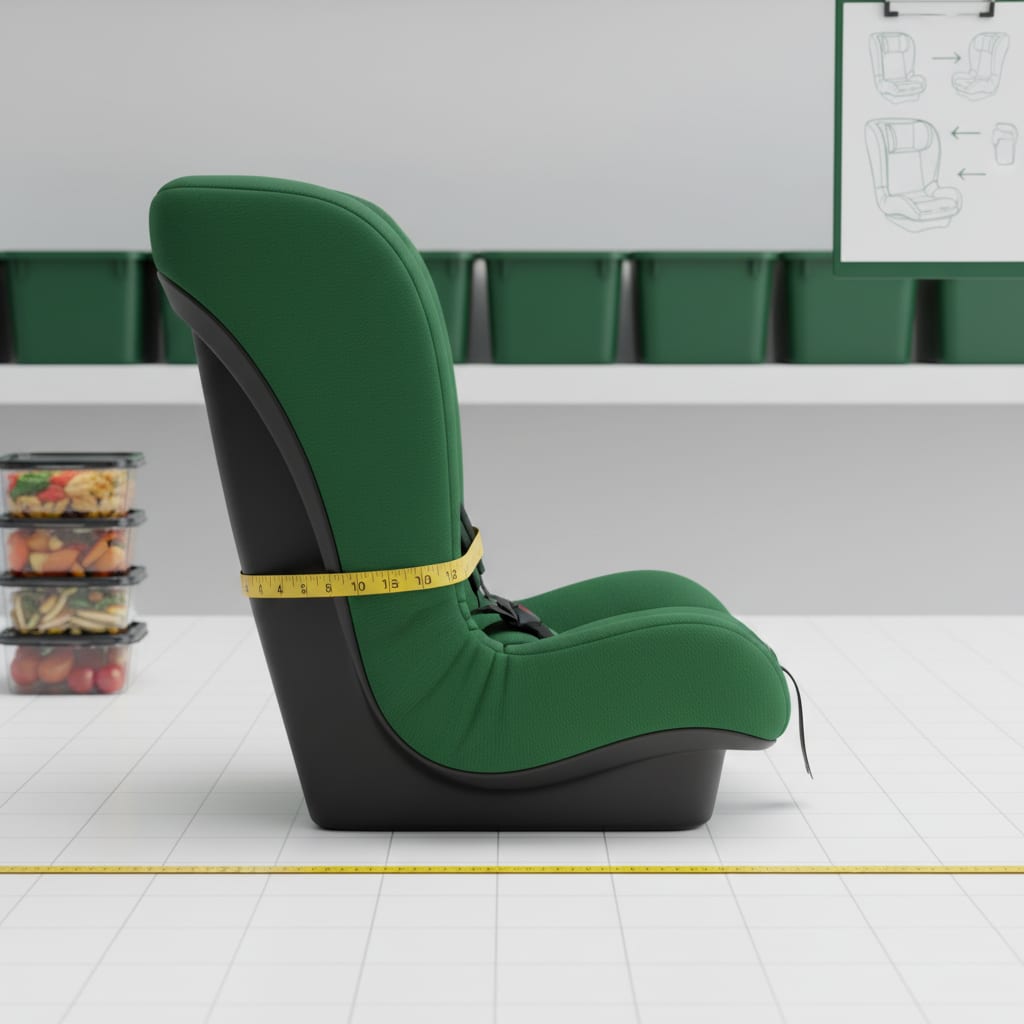
Recline angle. Rear-facing seats have a level line or an indicator on the shell for a reason: too upright is exactly what lets a young baby’s head fall forward. Check it every time the seat is reinstalled, not just when it’s new. Vehicle seats slope differently, so a seat that was fine in one car may need a different angle in another — which comes up constantly if you’re swapping seats between vehicles or refitting them across a full bench.
Harness fit. Straps snug, no slack you can pinch at the shoulder, chest clip at armpit level, and no bulky coat between the baby and the harness.
Head position. If the chin is dropping toward the chest, the seat is probably too upright or the insert isn’t doing its job. Sort it before you drive on.
Bulk you’ve added. Aftermarket head supports, strap covers and inserts that didn’t come with the seat are not tested with it and can change how the baby sits. If it wasn’t in the box, it doesn’t go in the seat.
And when the seat starts getting tight, the answer isn’t turning it round early — the rear-facing limits on your seat still govern that decision.
FAQ: time limits in a car seat
How long can a newborn be in a car seat?
Less than an older baby — newborns have the least head control, which is what the limit is about. Keep trips short, take the baby out at stops, and if your baby was premature or small, ask your pediatrician or the hospital for guidance specific to them rather than using a general figure.
Is the two-hour car seat rule a real rule?
It’s a widely used rule of thumb rather than a law, repeated in pediatric advice and in many manufacturers’ manuals. Treat it as a planning limit, check whether your own seat’s manual states its own figure, and pay at least as much attention to the baby’s position as to the elapsed time.
Can a baby sleep in a car seat overnight?
No. The AAP’s position is that sitting devices aren’t for routine sleep; a baby who falls asleep in a car seat should be moved to a firm, flat sleep surface on their back as soon as possible. That applies to naps at home as much as to overnight.
Does time in a stroller count toward the limit?
Yes, if the carrier is clicked into a stroller frame — the baby is still in the same semi-upright position. Count car time and travel-system time together.
How often should you stop on a long drive with a baby?
Often enough that the baby isn’t in the seat beyond the limit you’re working to, which for most families means a proper stop roughly every couple of hours, with the baby fully out of the seat each time. Bundle everyone else’s needs into that same stop.