Does Insurance Cover a Car Seat After a Crash?
Insurers often do reimburse car seat replacement after a crash, but nobody online — including us — can tell you what your policy covers. Ask your own insurer, claim number in hand. What isn’t optional is the safety half: NHTSA recommends replacing child seats after a moderate or severe crash, and its bar for calling a crash minor is high enough that most families should assume replacement. Sort the safety decision first, then chase the money. Never the other way round.
With three or more seats in the vehicle, that’s not one purchase — it’s a line item, which is exactly why it’s worth knowing how the claim conversation goes.
Start with NHTSA’s five-part minor-crash test
NHTSA’s guidance is that seats should be replaced after a moderate or severe crash. A crash counts as minor — meaning the seat may continue to be used — only if all of the following are true:
- The vehicle could be driven away from the crash site.
- The vehicle door nearest the car seat was undamaged.
- None of the vehicle’s passengers were injured in the crash.
- If the vehicle has airbags, no airbags deployed.
- There is no visible damage to the car seat.
All five. Not four of five, not “mostly”. A shunt that leaves the near-side door creased fails the test even if nobody so much as bumped a knee, and a deployed airbag ends the conversation on its own.
Two details families get wrong. It applies to every child restraint that was in the vehicle — occupied or not, because an empty seat absorbed the same forces. And invisible damage is the entire point: shell stress and webbing damage don’t announce themselves, so “it looks fine” is not evidence.
Your manual may set a stricter bar than NHTSA
Before you decide anything, open the car seat manual and find the crash section. Several manufacturers instruct owners to replace the seat after any crash, with no minor-crash carve-out. Their instruction governs their product — if the manual says replace, replace, regardless of how the five criteria read.
Lost the manual? It’s on the manufacturer’s site under your model number, and their customer service line will answer directly. Have the model number and date of manufacture ready.
Whether insurance pays is a policy question — here’s how to ask it
Car seat replacement is commonly handled as part of a vehicle damage or property claim, and plenty of families are reimbursed — but coverage varies by insurer, policy, state and whose insurance is paying, so don’t take a stranger’s answer for it. Ask yours, this way:
- Open the claim first, then raise the seats as a specific item — “there were three child restraints in the vehicle at the time of the crash, all of which the manufacturer requires be replaced.” Naming the manufacturer’s requirement is stronger than naming your preference.
- Ask for the answer in writing, or note the date, time and name of whoever tells you. Verbal assurances evaporate at reimbursement time.
- Ask whether it’s like-for-like or capped, and whether they want the old seats surrendered. Some do.
What to have in front of you before you call
Every one of these is faster to collect now than to reconstruct in three weeks, and an adjuster who gets them in one email usually stops asking for things:
- The claim number, plus the date, time and location of the crash.
- The police or incident report number, if one was filed — it establishes severity for an adjuster who never saw the vehicle.
- Make, model and date of manufacture for every seat that was in the vehicle, occupied or not. All three sit on the same label you’d check for the seat’s expiry date — photograph it rather than transcribing it.
- The manual page that requires replacement, or its link on the manufacturer’s site. The single most useful attachment in the file.
- Photographs: each seat as installed, the vehicle damage, and the door nearest each seat.
- An itemised receipt for each replacement, once you buy.
Ask which of two numbers they’re paying
There are two standard ways an insurer values a replaced item, and across four seats the difference is not small. The NAIC defines them in a homeowners context, but they are the same two words to put to an auto adjuster (page loaded 2026-09-19): actual cash value pays “the cost to repair or replace your home or personal property based on its value, considering its age and wear and tear (depreciation),” while replacement cost value pays “the cost to repair or replace your damaged property using materials of a like kind and quality.”
On a car seat that matters, because an actual-cash-value settlement values a four-year-old convertible as a four-year-old convertible and you make up the gap. Ask it in those words — “actual cash value or replacement cost?” — and if it’s the first, ask what depreciation schedule applies. You may not change the answer; you will know what you’re being offered before you spend.
Two practical notes. Keep the damaged seats until the claim settles — an insurer may want to inspect them, and destroying them early can cost you the money. And don’t wait to replace if that leaves you without a safe way to move your kids: buy now, claim the receipts, because an unbuckled kid is not a negotiating position.
The multiplier problem: one crash, four seats
A minor bump that costs a two-seat family one replacement costs us four, with no shopping-around window — everyone still needs to get to school on Monday. What softens it:
Photograph the installed seats now. Each seat as installed plus a close-up of each model label takes five minutes and turns items 3 and 5 above into a forwarded email instead of a memory test. Note which seats are in which vehicle and in which positions; families running two vehicles and a shuffling roster lose track, and the claim asks.
Know your fallback configuration. Down to two working seats, which kids ride with whom — and does it fit? If the answer relies on a three-across arrangement, know your combos from the 3-across fit guide before you’re solving it in a car park.
Rebuild in priority order: school-run seats first, spare-vehicle seats second. Check the third-row positions you’re refilling still have the tether anchors the new seats need.
Never resell, donate, or “just keep it as a spare”
A seat that meets the replace-it threshold leaves circulation entirely — not to a cousin, not to a charity shop, not into the loft as the backup somebody grabs in a hurry three years from now.
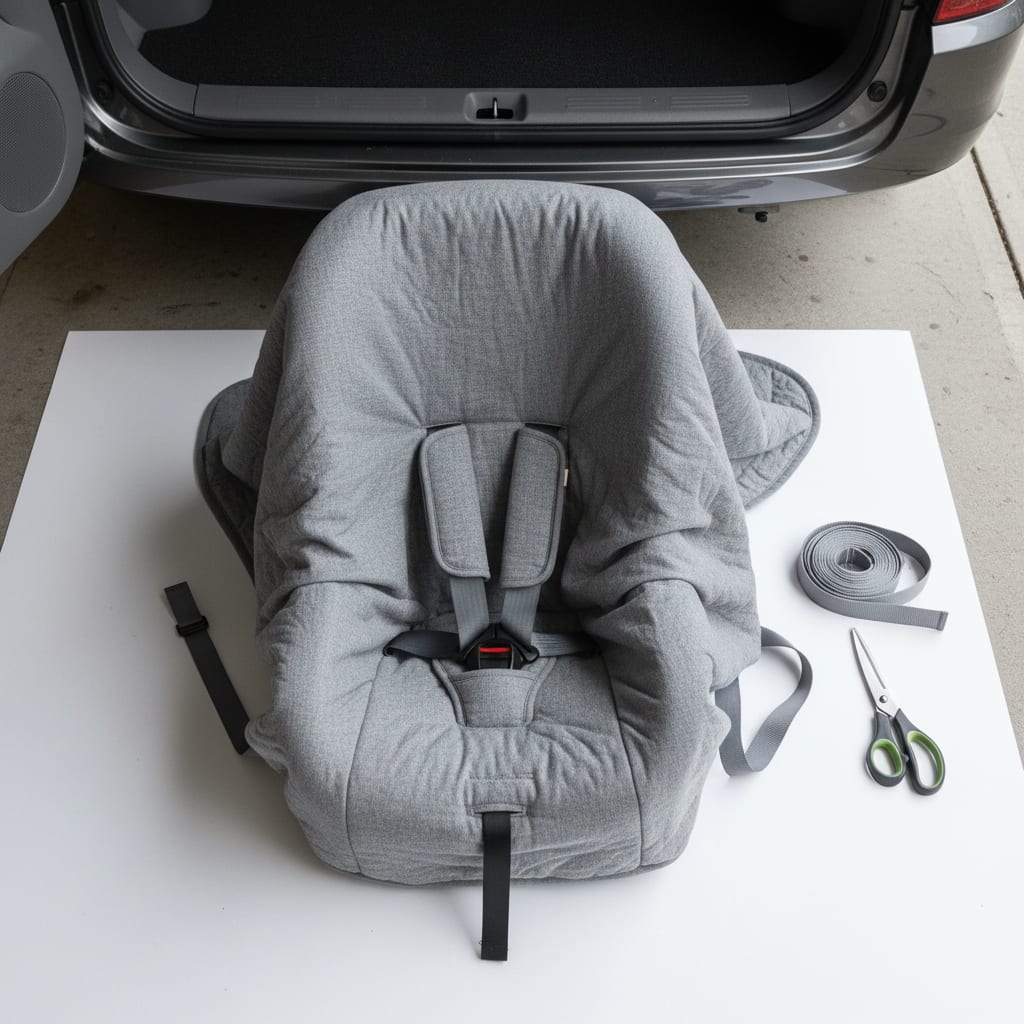
Once the claim is settled and the insurer has confirmed they don’t want it: cut the harness straps, strip the cover, and mark the shell so it can’t be salvaged. It feels wasteful when the thing looks perfect. That’s precisely the situation the rule exists for.
FAQ: car seats after a crash
Do you have to replace a car seat after a minor accident?
Not necessarily — but “minor” has a specific meaning. NHTSA treats a crash as minor only if the vehicle was drivable, the door nearest the seat was undamaged, nobody was injured, no airbags deployed, and the seat shows no visible damage. If any one of those isn’t true, replace it. Your seat’s manual may require replacement after any crash regardless.
Will insurance pay for a new car seat after a crash?
Often, but it depends entirely on your policy, your insurer and your state, so ask them directly and get the answer in writing. Raise the seats as a specific item on the claim, cite the manufacturer’s replacement requirement, and keep the receipts and the damaged seats until it’s settled.
Does an empty car seat need replacing after a crash?
Yes, if the crash meets the replacement threshold. The seat was installed in the vehicle and took the same forces whether or not a child was in it.
How do you know if a car seat is damaged after a crash?
You generally can’t by looking, which is why the guidance is written around crash severity rather than inspection. Stress to the shell and webbing isn’t reliably visible, so an undamaged appearance doesn’t clear a seat that fails the minor-crash test.
Can you sell or donate a car seat that’s been in a crash?
No. Retire it, destroy it so it can’t be recovered and reused, and dispose of it — after checking whether your insurer wants to inspect it first.