One Dinner, Five Kids: Picky Eaters at a Full Table
The way to feed five kids with five different opinions is one dinner, served in parts: cook a single meal, put its components on the table separately instead of combined, guarantee one “safe” component per plate, and hold two rules without drama — you don’t have to eat it, and I’m not cooking anything else. That’s the whole system. It ends short-order cooking the night you start it, and it slowly widens what kids eat, because the pressure is gone and the food keeps showing up.
At my table that’s seven plates a night, five of them under twelve, and exactly one dinner. Here’s the machinery.
The no-short-order rule
The big-family math makes this one non-negotiable: separate meals scale with headcount. One accommodation for one picky kid is a favor; at five kids it’s a second dinner service, and I’ve worked dinner service — you don’t run one for free. So the kitchen makes one meal. Not because flexibility is bad, but because a system that requires mom to be a diner cook collapses by Wednesday, and collapsed systems feed nobody.
The rule only stays kind because of what comes next: nobody’s forced to eat anything, and nobody leaves the table hungry, because every dinner ships with a component we already know each kid accepts.
Serve it deconstructed
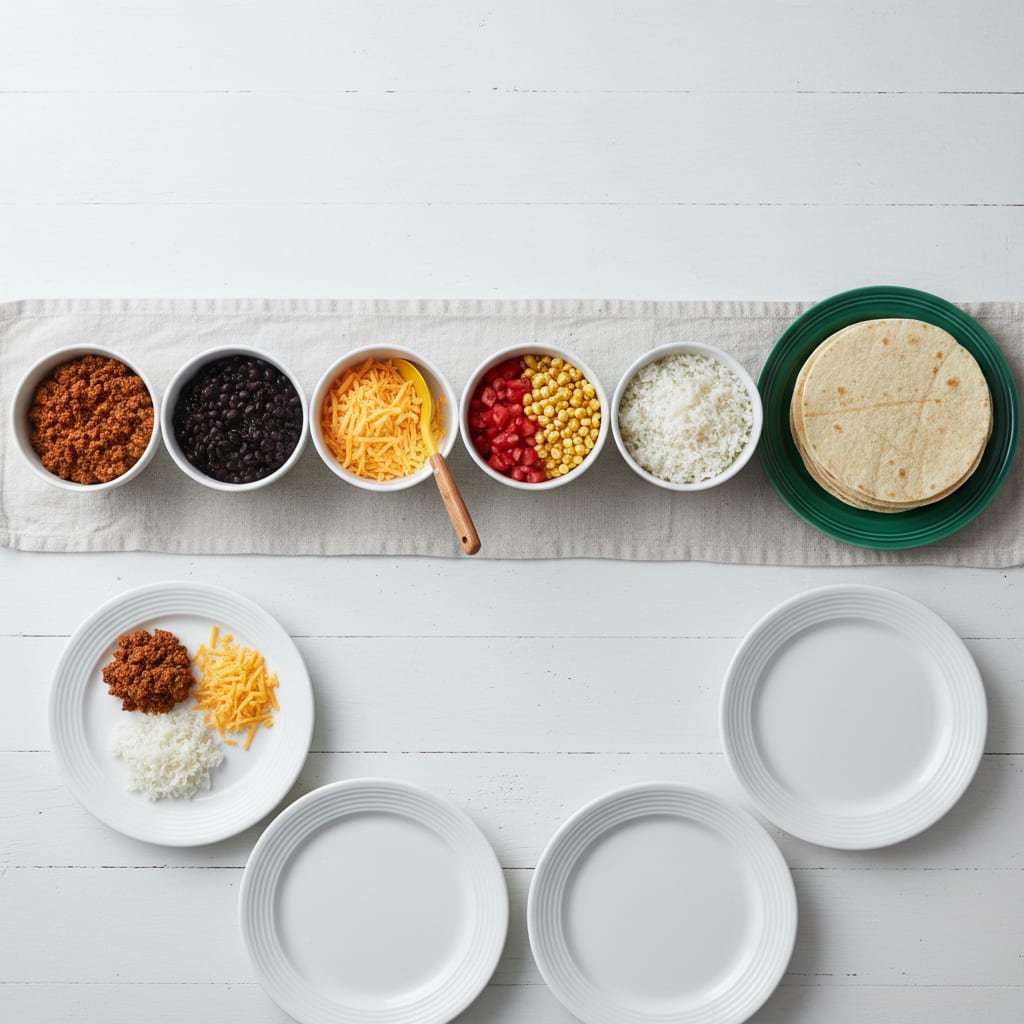
Combined food is where picky dinners go to die. The casserole is a take-it-or-leave-it proposition; its ingredients, served separately, are a menu. So the same dinner leaves my stove in parts: taco night is a line of bowls — meat, beans, cheese, tortillas, toppings — not assembled tacos. Pasta night is noodles, sauce on the side, protein on the side. Sheet-pan night comes zoned by design — the two-pan system roasts potatoes, carrots, and broccoli in stripes precisely so the pan itself offers choices without anyone cooking twice.
Deconstruction costs the cook nothing — it’s the same food, un-stirred — and it converts every dinner into a build-your-own bar. My twins eat the same pasta night as everyone else; one of them just eats it in three separate piles. Fine. The kitchen closed on time.
The safe-component guarantee
Every dinner includes one thing each kid reliably eats — rice, tortillas, fruit, the cut vegetable tray that hits the table while I’m still plating. Not a special meal; a component of this meal. It does two jobs. First, it makes “you don’t have to eat it” an honest sentence instead of a bluff, because a kid who skips the chili still assembles a dinner from rice, cheese, and fruit. Second, it takes the fight out of the room — nobody negotiates when nobody’s cornered.
Planning the safe component is a one-line habit inside the weekly meal plan: next to each dinner, note the floor. Most nights the floor is the carb, and cheap carbs are already doing the heavy lifting in every big-family dinner rotation — the economics and the diplomacy run on the same rice.
What the table sounds like
The script is short and boring on purpose. “This is dinner. Eat what you like.” No selling, no bite-counting, no dessert ransom — bribes teach kids that vegetables are the toll and dessert is the destination, which is the exact opposite of the lesson. Commentary about food (theirs or a sibling’s) gets redirected the same flat way every time: you don’t have to eat it, you do have to let others enjoy it. In a big family the audience is the accelerant — one dramatic “ew” from a nine-year-old can take out two younger opinions like dominoes, so the no-commentary rule matters more at a full table than it ever did with one kid.
And the food keeps showing up. The research consensus on picky eating is unglamorous: repeated low-pressure exposure is what moves the needle, and it can take many exposures — often ten-plus — before a new food gets accepted. A big family is actually built for this, because the rotation repeats weekly and the skeptic watches four other kids eat the thing every single time. The table does the marketing so I don’t have to.
One honest boundary: this system is for ordinary picky eating — the most common kind. A kid whose list of accepted foods is shrinking, or who gags, panics, or is falling off their growth curve, needs a pediatrician, not a blogger’s serving strategy.
FAQ: picky eaters at family scale
Isn’t “eat it or don’t” just letting them go hungry?
No — that’s what the safe component is for. Every dinner includes something each kid accepts, so opting out of the main dish still yields a plate. The kid controls what goes in; the kitchen controls what’s offered. Both sides keep their job.
What about the kid who only eats the safe food every night?
Let it ride longer than feels comfortable. The floor foods are real food, exposure keeps working while they watch everyone else eat, and most kids expand when the audience pressure is off. If weeks pass with zero movement, tighten gently — keep the floor, shrink its portion — rather than reopening negotiations.
Do I really never make a separate meal?
At headcount, yes — one dinner. The flexibility lives inside the meal: deconstructed parts, a zoned pan, sauce on the side. That covers the honest range of kid preferences without opening a second kitchen. The exceptions are actual medical needs — allergies and diagnosed feeding issues aren’t pickiness and don’t play by these rules.
How long until the table gets calmer?
The fights usually fade within a couple of weeks, because the system removes the thing fights need — leverage. Actual food acceptance is slower: think months of quiet repeated exposure, not a breakthrough week. The order matters, though. Peace first, progress second, and the first one is worth the price of admission on its own.